

3 priorities for your business for 2026 and beyond
As the tech landscape continues to develop and change, how can businesses keep on top of emerging trends, reduce risk and support their employees?

There has been no denying that the tech world is facing huge tech talent cliffs as AI continues to change the landscape. The threat of being left behind looms over businesses globally, but what are the three non-negotiable priorities to every business globally, and how can you best implement them?
The World Economic Forum reported that technology-related roles are the fastest-growing jobs, with AI and big data topping the list of fastest-growing skills, followed closely by networks and cyber security as well as technology literacy.
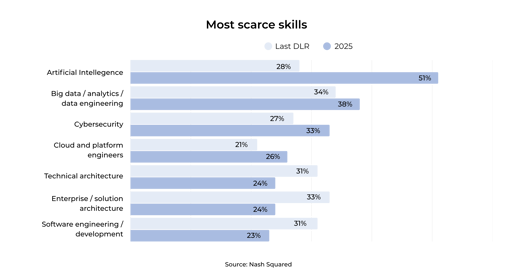
Nash Squared highlighted the same with the highest skills shortages being in AI (51%), big data (38%) and cyber security (33%). These three skills are also at the core of what should be the main 3 priorities for organisations for 2026 and beyond.
With increasing cyber threats, the development of AI and the risk of losing data, how can companies understand their weaknesses, close their talent gaps with structured learning and development, and build a brighter future for themselves and their employees?
Written by
Ryan is a specialised corporate learning and development (L&D) manager who advises businesses on the best training solutions for their staff. He has collaborated with hundreds of companies to understand the specific skill gaps in teams and conduct thorough competency benchmarking. This means he has a deep understanding of where workforces are often strong and where they tend to fall behind in terms of digital skills.

1. AI Implementation
A core focus for businesses over the last 2 years or so has been effectively implementing AI tools and strategies, showcasing its value, and not only that, but protecting assets from the risks external AI can create.
This will continue to be the case into 2026 and beyond as AI tools and programmes continue to be developed. Even basic AI literacy training along with creating clear policies and guidelines within organisations to avoid exposing vulnerabilities by sharing sensitive documents within basic LLMs.
As it stands, according to D2L’s Upskill with Purpose report, employees are already feeling optimistic with 64% saying their company already provides tools and encourages AI innovation. Although there is confidence, 75% acknowledge they will need to supplement those skills to be able to advance professionally in the next three years.
Around 65% of the skills needed for existing jobs will have changed by 2030, with AI being the main driver, putting jobs at risk, not from workers being replaced by AI, but if employees do not gain some AI skills.
2. Cyber security
2025 saw a jump in cybercrime, in fact, Nash Squared reported that 29% of digital leaders were subjected to a major attack in the last 2 years. Fortinet similarly reported that 86% of businesses reported having had one or more breaches in 2024, with 28% reporting five or more, making this a business-critical focus globally.
Cyber-attacks can be catastrophic for businesses, with the recent Jaguar Land Rover being named the most economically damaging cyber event in UK history, costing the company £1.9bn.
The top three causes of breaches according to the Fortinet research are lack of security awareness (56%), lack of IT security skills and training (54%), and a lack of cyber security products (50%).
A big movement in cyber security, both to defend and attack, is the implementation of AI, but the report stated that 48% of IT leaders’ lack of staff with AI expertise is the biggest challenge they face. A report by Pluralsight echoed that tech practitioners ranked cyber security as the most important skill for them to learn in 2026.
Despite the need for trained cyber security professionals, only 73% of businesses would pay for an employee to obtain a cyber security certification.
Cyber professionals are necessary for protection
"Skilled and aware employees and cyber security professionals are crucial to overall cyber risk management in a world that is moved beyond the attack-and-defend cycle. Today, to protect themselves, organizations need to maintain a posture of perpetual vigilance and continuous risk awareness."
3. Data and Analytics
Data has and always should be a priority for businesses to help enable better decision making, increase efficiency and improve understanding of your customers and clients. Data is the key way to identify new opportunities and growth areas and even anticipate trends.
With the rise of sophisticated cybercrimes is a better time than ever to not only protect your data, but to truly understand it and use it to your advantage.
The World Economic Forum reported that ‘Big Data Specialists’ will be the top fastest growing job from 2025-2030. Further developments in AI will require a better understanding and handling of data with Pluralsight predicting we will move away from static data toward temporal data to help build resilient AI systems.
Data to become fundamental to business success
“The next breakthroughs will emerge from understanding how data changes—particularly, its rhythms, signatures, and trajectories over time. By 2026, analytics of temporal data will no longer be a specialized skill but a fundamental competency for leaders building resilient AI systems.”
Saving time and money – utilise the skilled workers you already have
The continuing message in these areas is a need for skilled professionals, but building a new team can be time consuming and costly, so how can this be mitigated?
Pluralsight cited that 89% of organisations say hiring is more expensive than upskilling for IT roles, with 89% of companies saying it took longer to hire and train a new employee rather than upskill an existing one.
Investing in your staff is the answer
“The threat is that if no company gives juniors a chance, then they won’t become intermediate or senior developers, and there will eventually be a large gap that will be difficult for leaders to fill. Simply put, you need to invest in people so they can grow, and if AI doesn't evolve to replace all developers, then there’s probably going to be a big knowledge gap.”
The clear best solution? Upskill and invest in your current staff.
Not only is investing in your current talent pool beneficial for the business by saving time and money, but it also shows you value your employees and offers them a solution to challenges they are facing.
The D2L report noted that offering tangible incentives, such as financial rewards, dedicated training time during work hours and flexible learning formats can further increase participation and engagement from workers.
Business Learning & Development with Learning People
We support organisations with bespoke, benchmarked workforce upskilling across a range of other areas, including:
- AI and data readiness
- cyber awareness and resilience
- compliance and audit readiness
- leadership and management
- and much more
Our fully managed and structured learning and development programs empower your workforce to perform with high levels of confidence, judgement, and accountability.
Contact us today for a free consultation and team skills gap analysis.
—
Discover your team's training needs in a free 30 minute consultation
Find out how we can help
Talk to one of our dedicated learning and development account managers so we can understand more about your business
Read more about workforce upskilling
 Cloud & Microsoft
Build Billable Cloud Capability Faster: An MSP's Guide to Closing the Bench-Depth Gap
Reaching AWS Advanced, Premier, or Microsoft Solutions Partner status depends on a specific count of certified staff and your bench depth. This guide maps the certification pathways for AWS, Microsoft and CompTIA, and explains why upskilling existing engineers closes the gap in weeks, while hiring takes months.
Read More Closing the Skills Gap
Upskilling vs Hiring: The Real Cost of Closing a Technical Skills Gap in 2026
Hiring looks simple but rarely is the cheaper option. And I've done the hard work for you: compared the real costs of recruiting versus upskilling, explained why retention improves when you invest in your people, and shared four questions to help you choose the right path for your team's skills gap.
Read More Closing the Skills Gap
How to Build the Internal Business Case for a Workforce Upskilling Program
Winning budget for upskilling means proving it beats hiring on cost and speed, tying training to certification pathways, and measuring capability uplift - not course completions - against real business outcomes like reduced delivery delays, fewer audit findings, and better retention.
Read More Closing the Skills Gap
Beyond Course Completion: How to Measure ROI in Learning and Development
Course completion rates prove content was consumed, not capability gained. This guide sets out a practical framework for measuring L&D ROI: benchmark skills before training, set role-based targets, validate with external certifications, and report progress to the managers accountable for results.
Read More