

Upskilling vs Hiring: The Real Cost of Closing a Technical Skills Gap in 2026
Hiring looks simple but rarely is the cheaper option. And I've done the hard work for you: compared the real costs of recruiting versus upskilling, explained why retention improves when you invest in your people, and shared four questions to help you choose the right path for your team's skills gap.

With ever-evolving tech like AI, the pressure to fill your organisation's skills gap isn't going anywhere.
Cornerstone recently reported that that for every 1,000 employees, the cost of unaddressed culture and capability failures reaches AUD $1.64 million in Australia and NZD $1.33 million in New Zealand. 85% of these costs stem from employee retention issues and absenteeism rather than hiring inefficiency, highlighting the necessity of learning and development.
This article is for the person who owns the hiring verses upskilling decision, and has to defend it upstairs. I understand the desire to hire: a new name on the org chart is easy to highlight to colleagues and senior management alike. Before you post the advert, pause and do the numbers. After all, the salary you'd offer is the smallest part of what hiring costs, and the course fee is the smallest part of what upskilling gives back.
Written by
Based in our UK office, Alex leads Learning People globally, helping thousands of individuals each year develop in-demand skills in tech, project management, cybersecurity, data, and AI. He enjoys building businesses, solving complex problems, and bringing together great people around a shared vision.

Upskilling vs Hiring: The Numbers Side-By-Side
For most mid-market organisations in 2026, upskilling existing staff closes a technical skills gap faster and at lower total cost than hiring. A permanent hire carries recruitment fees, months of vacancy, a market-rate salary premium and the risk of early attrition. A certification-backed upskilling programme costs a fraction of that, and it turns people you already employ (and trust) into the capability you're missing. Hiring is can be the right call when you need a skill nobody in the building has, or you need it on day one. But, the economics almost always favour upskilling.
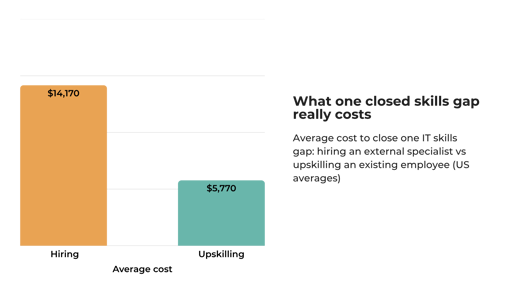
Pluralsight's latest Tech Skills Report puts the average cost of one external IT hire at $14,170, against $5,770 to upskill an existing employee (US averages, but it's the ratio that matters). The same research found that 89% of organisations now say hiring is more expensive than upskilling for IT roles. A year earlier that figure was 49%. Here's the costs, challenges and potential outcomes side-by-side:
| Challenges to consider | Outcomes of hiring | Outcomes of upskilling |
| Up-front cost | Agency fees plus a market-rate salary premium ($14,170 on average for an IT role) | Programme and certification fee per learner ($5,770 on average) |
| Time to capability | Months of advertising and interviews | Training runs alongside the day job |
| Where the skills go long-term | They leave when the team member does | Stays in the team and compounds |
| Effect on pay bands | An above-band offer resets expectations across the team | Develops people within existing bands |
While you weigh up the pros and cons, the work lands on the people you already have. The on-call rota stretches while your best Software Engineer spends the quarter firefighting instead of working on strategy, and you have to explain the same uncompleted request at every monthly review. I've watched that cycle wear down more good teams than any technology choice ever has.
The cost shape of upskilling is simpler: a programme and certification fee per learner, plus protected study time that easily fits round existing responsibilities.
Did You Know? 88% of Organisations Are Concerned About Employee Retention
LinkedIn's 2026 Talent Report revealed that found 88% of organisations are concerned about employee retention. And the top-ranking solution? Providing learning and development opportunities.
People stay where they're developed, and every professional who stays is a vacancy you never have to open.

How to Make the Hiring vs Upskilling Decision
If the next step to closing the skills gap is still unclear, I always ask businesses these four questions:
- Is there a foundation to build on? If someone on the team is one or two certifications away from having the necessary skills and knowledge, upskilling is the best solution. If nobody is, price a hire or a contractor for the lead role first.
- When is the real deadline? If you don't need the capability immediately, why not minimise spend and empower an employee through relevant training.
- Will you need these skills again? A recurring need favours upskilling because retained capability compounds. For a genuine one-off, look to a new hire or contractor.
- What does each path cost in full? Fees, premium, empty months and attrition risk on one side; programme, certification and study time on the other. Compare like for like and then decide next steps.
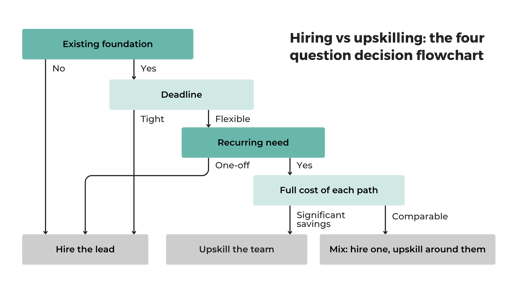
Most mid-market gaps in cloud, cyber, data and project management come out of those four questions the same way: hire the lead when you genuinely must, and upskill everyone else.
Upskill Your Team: Getting Started
We support organisations with bespoke, benchmarked workforce upskilling across a range of areas, including:
- project delivery
- cyber awareness and resilience
- data and AI readiness
- and much more.
Our fully managed and structured learning and development programs empower your workforce to perform with high levels of confidence, judgement, and accountability.
Contact us today for a free consultation and team skills gap analysis.
—
Discover your team's training needs in a free 30 minute consultation
Find out how we can help
Talk to one of our dedicated learning and development account managers so we can understand more about your business
Read more about workforce upskilling
 Cloud & Microsoft
Build Billable Cloud Capability Faster: An MSP's Guide to Closing the Bench-Depth Gap
Reaching AWS Advanced, Premier, or Microsoft Solutions Partner status depends on a specific count of certified staff and your bench depth. This guide maps the certification pathways for AWS, Microsoft and CompTIA, and explains why upskilling existing engineers closes the gap in weeks, while hiring takes months.
Read More Closing the Skills Gap
Upskilling vs Hiring: The Real Cost of Closing a Technical Skills Gap in 2026
Hiring looks simple but rarely is the cheaper option. And I've done the hard work for you: compared the real costs of recruiting versus upskilling, explained why retention improves when you invest in your people, and shared four questions to help you choose the right path for your team's skills gap.
Read More Closing the Skills Gap
How to Build the Internal Business Case for a Workforce Upskilling Program
Winning budget for upskilling means proving it beats hiring on cost and speed, tying training to certification pathways, and measuring capability uplift - not course completions - against real business outcomes like reduced delivery delays, fewer audit findings, and better retention.
Read More Closing the Skills Gap
Beyond Course Completion: How to Measure ROI in Learning and Development
Course completion rates prove content was consumed, not capability gained. This guide sets out a practical framework for measuring L&D ROI: benchmark skills before training, set role-based targets, validate with external certifications, and report progress to the managers accountable for results.
Read More