

Leak of 48 Million+ Gmail Logins Highlights the Need for Certified Cyber Security Professionals
The leak of 48 million Gmail usernames and passwords during Data Privacy Week underscores the growing importance of closing the cybersecurity skills gap across APAC and globally.

2026 has not started off well for cybersecurity and data privacy. Users of the popular password manager LastPass received phishing emails earlier this month, leading to the leak of 149 million login credentials, including 48 million for Gmail accounts, in a massive data breach.
Jeremiah Fowler, a cybersecurity researcher who uncovered the leak last week, has confirmed that a staggering 149,404,754 unique logins and passwords for platforms including Gmail, Yahoo, Facebook, Instagram, Outlook, and Netflix have been exposed online in an unprotected database.
Although it is currently unclear who created this database, how they did it, and why, this collation of sensitive data from past breaches and infostealer logs clearly illustrates the need for more skilled, knowledgeable and qualified cybersecurity professionals in Australia and New Zealand to keep us safe.
Here’s what we know so far about this cyber attack, and how you can use learnings from Data Privacy Week to protect your data online.
Fact checked by
Adam is a Senior Career Consultant at Learning People, specialising in helping people move into IT, Project Management, Cyber Security, Software Development, and Cloud Computing roles through personalised 1:1 consultation. He understands well which skills and certifications employers value most in today’s fast-evolving tech landscape.

What we know so far about the Gmail data breach
Originally reported to ExpressVPN by Fowler, this publicly exposed database, made up of an enormous 96 GB of raw credential data, was not encrypted or password-protected. The 149 million+ unique logins and passwords contained in this dataset were arranged into countless publicly-accessible files.
Inside the dataset were login credentials for a variety of platforms, with the biggest hitter, Gmail, having a massive 48 million accounts compromised.
Here’s a breakdown of the biggest email providers and platforms that have been affected:
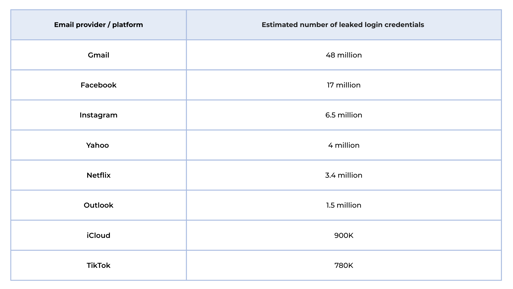
Unlike other recent significant cyber attacks - such as those on Australian flag carrier Qantas, and car manufacturer Jaguar Land Rover - this data breach was not a ransomware attack perpetrated through social engineering. Rather, this database was the result of using keylogging and ‘infostealer’ malware: a type of malicious software designed to silently collect credentials from infected devices.
The stolen data was organised by victim and source, including emails, usernames, passwords, and the exact login URLs.
Gmail data breach: risks and consequences
Because this dataset included emails, usernames, passwords, and the exact login URLs, criminals could automate ‘credential-stuffing’ attacks against compromised accounts, potentially gaining access to email, financial services, social networks and more. This dramatically increases the risk of fraud and identity theft for those affected.
Fact: there's a cyber incident every 6 minutes in Australia
The Australian Government's latest Annual Cyber Threat Report revealed that they received 84,700 cybercrime reports between 2024-2025 - this averages out to one report every 6 minutes.
Despite the average cost of one cyber attack in Australia costing between $56,600 to $202,700, there is still an on-going cybersecurity skills shortage.

What this means for cyber security and data privacy in Australia and New Zealand
Data privacy can feel more difficult in 2026 than every before because the volume and reach of data collection keeps growing. As we rely more on digital services and devices, the importance of mitigating data breaches - whether miscellaneous or otherwise - is now non-negotiable.
The theme ‘take control of your data’ for Data Privacy Week 2026, highlights how individuals and organisations can make better choices to treat personal data with the care it deserves.
But the bottom line? Increasing the number of certified cybersecurity professionals is key to reducing the risk of cybercrime.
As the Asia-Pacific region experiences the highest global rate of ransomware attacks, the demand for qualified cybersecurity professionals is increasing rapidly. In turn, employers are willing to pay cyber professionals far above the national average to avoid the huge cost of a cyber attack.
Our range of courses and pathways is created to equip you with job-ready skills from globally recognised cybersecurity certification providers like CompTIA, EC-Council, and Cisco.
If you’re looking to make a career change into cybersecurity with no experience, or if you’re looking to improve your skillset to stand out in a highly lucrative career, then why not arrange a free, no-obligation call with me or one of my colleagues to see how we can support you? We’re here to answer any questions you might have about cybersecurity qualifications or our services.
Related Articles
 Cyber Security
Understanding the different types of cyber security threats – December 2025
Discover the types of cyber security threats and how professionals tackle challenges like ransomware, phishing, and insider threats. Explore the risks posed by DDoS attacks and IoT vulnerabilities, and learn how Learning People’s expert-led cyber security courses prepare you for a future-proof career.
Read More Cyber Security
Data Privacy Week 2026: Why We Need More Cyber Professionals Protecting Our Personal Data
With Data Privacy Week 2026 upon us, this year's theme, “Take control of your data” highlights an urgent societal problem. Personal information now flows constantly through apps, devices, and organisations, often unnoticed, while cyber risks and skills shortages continue to grow. How do we close the cyber skills gap to ensure we treat global data privacy a priority?
Read More Cyber Security
Our Cybersecurity student success stories
We've helped thousands of students start new and rewarding careers in cybersecurity. Explore their stories to get excited about starting your own career in this growing sector.
Read More Cyber Security
What Is Cyber Security & Why Is It So Important in 2026?
Cyber security is more important than ever before — and so is filling the cyber skills gap with trained professionals in Australia, New Zealand, and globally! I'll cover the foundations of what cyber security is, what it entails, and why it's increasingly important for corporate and national safety, as well as what a career in this sector can look like.
Read More