

What to Do if You Can’t Get a Job After University: Career Expert Advice
Many graduates struggle to find a job after university, especially in a competitive early-career market. This guide explains why graduates can find it hard to stand out, how practical skills and certifications can strengthen your CV, and what steps to take next if your applications are not getting results.

If you can’t get a job after uni, I know how quickly it can start to chip away at your confidence. You spend years working towards a degree, send off application after application, and then hear nothing back.
I know you might be questioning whether university was worth it in the first place. But struggling to find a job after graduation does not mean your degree was pointless, and it definitely does not mean you won’t be successful in your career.
I’ve written this guide as a practical follow-on from our advice on what to do after university. This is not a “keep applying, something will come up” pep talk. I want to help you understand what employers may be looking for and what you can do to move forward.
Written by
With over 3 years working at Learning People supporting students in their career search, Flo is here to offer one-to-one personal guidance, which proactively supports you as you venture towards your new or expanded career.

What's on this page?
Jump to:
- Why You Might Be Struggling to Get a Job After University
- The Skills Gap That Can Hold Graduates Back
- A Practical Action Plan if You Can’t Get a Job After Uni
- Build a Portfolio Even if You Have Never Had a “Proper” Job
- Use Networking
- Should You Take Any Job After University?
- Final Thoughts: Your Next Step Is About Building Evidence
- What to Do if You Can’t Get a Job After University: Career Expert Advice FAQs
Why You Might Be Struggling to Get a Job After University
Not being able to get a job after university, does not mean you are lazy, unmotivated, or that your degree was a waste of time.
I know you might start questioning things after weeks or months of applications. But in most cases, the issue is not your ability. It is the gap between what your degree shows and what employers are looking for on a resume and application.
University gives you valuable knowledge, including:
-
Discipline
-
Research skills
-
Independent working
-
Written communication
-
Problem-solving
-
Subject knowledge.
Many recruiters are also looking for evidence of workplace-ready skills, such as:
-
Specific tools or platforms
-
Recognised certifications
-
Practical projects
-
Portfolio work
-
Commercial awareness
-
Keywords that match the job description..
That is why some “graduate” roles can feel so confusing. They are advertised as entry-level, but then ask for experience, commercial awareness, software knowledge, or examples of practical work.
It is frustrating, and I do not blame any graduate for feeling fed up with it. But it also gives you something useful to work with. If your degree proves you can learn, your next step is to show employers how that learning connects to the work they need done.
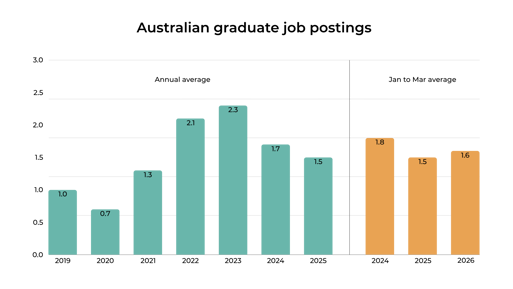
Fact: Australian Employers Are Still to Recruiting Graduates in 2026
In 2025, there were 1.5 times as many graduate job postings as in 2019 in Australia. Demand for graduates has begun to stablise in 2026, with graduate postings rising by 6.4% when compared with the same period in 2025 (January-March).
Hiring volumes are expected to remain stable, but graduate teams are under pressure because application numbers have risen while recruitment resources have not. That is encouraging for graduates, because opportunities are still there.
But it also shows why a general CV may not be enough in a crowded market. Applications need to show a clear match through relevant skills, practical evidence, and role-specific training.
The Skills Gap That Can Hold Graduates Back
After enough rejected applications, it is very easy to start rewriting the whole story in your head. Maybe I picked the wrong degree. Maybe I should have studied something else. Maybe I’m already falling behind.
I hear this a lot from graduates, and I do understand it. Your degree is not just a qualification. It represents years of work, money, pressure, and late nights studying. So when employers do not respond, it can feel personal and upsetting.
But silence from employers is not always a judgement on your potential. Often, it comes down to crowded applicant pools, CV filtering systems, and a lack of clear evidence around the practical skills they want to see.
Depending on the roles you are applying for, that missing link could be:
-
Cybersecurity fundamentals
-
Data analysis tools such as Excel or Power BI
-
Project management methods like AgilePM Foundation or PRINCE2
-
Coding basics in languages such as Python or JavaScript
-
Cloud or IT support knowledge
-
Practical experience using common workplace platforms
This is where I often talk to graduates about a strategic skills injection. By that, I mean adding one focused, relevant skill or certification that makes your CV stronger quickly. Not more study for the sake of it.
The right, targeted certification can help recruiters and applicant tracking systems understand you are the right candidate for a position. It does not replace your degree. It adds a practical layer to it. If you want to compare options, you can explore tech and project management courses that are built around job-ready skills.
A Practical Action Plan if You Can’t Get a Job After Uni
If you can’t get a job after uni, the answer is not always to send more applications. Sometimes, the better move is to pause, look at what the market is asking for, and make your next applications much sharper.
1. Audit the roles you keep applying for
Start by looking at 10 to 15 job descriptions for roles you genuinely want. Not dream roles from ten years in the future, but realistic first-step roles.
As you read them, highlight repeated:
-
Tools
-
Certifications
-
Technical skills
-
Soft skills
-
Job titles
-
Phrases or keywords
You are looking for patterns. If Excel, AgilePM Foundation, CompTIA A+, or customer support experience appears repeatedly, that is useful information. Our job market insights can also help you understand what employers are asking for across different areas.
2. Find the skill gap you can close fastest
Do not try to fix everything at once. Pick one relevant skill area that appears often in the roles you want. The aim is to make your resume more relevant quickly, not overwhelm yourself with multiple new directions.
3. Add evidence
A CV that says “strong communicator” or “fast learner” is easy to skim past. Those things are useful, but employers see them all the time.
Stronger evidence looks like:
-
A short case study
-
A practical example from university work
-
A portfolio project where you used a specific tool
This is where graduates can become competitive even without formal work experience. If that feels like the biggest barrier for you, our guide on how to get a job with no experience is a helpful next read.
4. Apply more narrowly
Fewer, better applications often beat sending the same CV everywhere.
Tailor your CV around the role’s real requirements. Use the same language employers use but don’t just force keywords in. Make it easy for a recruiter to see the match between you and the job.
Fact: New Zealand Public Service ICT Security Specialist Roles Grew by 324%
New Zealand Digital Government data shows that public service ICT Security Specialist roles grew by 324% between 2017 and 2024, rising from 41 to 174 roles.
The growth has been shaped by cloud computing, cybersecurity threats, and the need to improve productivity across public agencies. For graduates looking at tech careers, this points to the value of building practical cybersecurity and cloud skills.
Build a Portfolio Even if You Have Never Had a “Proper” Job
If you have not had a “proper” job yet, a portfolio can help you show employers what you are capable of. Paid experience is useful, of course, but it is not the only way to prove you have practical skills.
A simple portfolio could include:
-
A small data dashboard
-
A website or coding project
-
A cybersecurity lab write-up
-
A project plan
-
A case study from university coursework, rewritten to show the workplace problem, process, and outcome
This does not need to be perfect or wildly impressive. In fact, please do not spend three months trying to create the most beautiful portfolio the internet has ever seen. The aim is to give employers something concrete to look at.
A portfolio helps shift the conversation from “I’m interested in this field” to “Here is what I can do.”
If you are not sure where to start, our guide on how to build a professional portfolio explains how to turn your skills, projects, and learning into evidence employers are looking for.
Use Networking
Networking can sound like the last thing you want to do when you are already feeling rejected. The word alone makes some people imagine stiff events, forced small talk, and asking strangers for a job. Thankfully, it does not have to be that.
Networking can be as simple as:
-
Asking someone on LinkedIn how they got into their role
-
Leaving a thoughtful comment on a post from someone in your target industry
-
Joining a webinar and asking one useful question
-
Speaking to course mentors, tutors, or career advisors
-
Reconnecting with someone from university who has moved into a role you are interested in
The point is to learn how people enter the field, what employers look for, and which skills are worth building first.
Those conversations can also lead to referrals, advice, or opportunities you would not find through job boards alone. Our professional networking guide has more practical advice on how to start networking.

Should You Take Any Job After University?
Yes, if you need income, it is completely okay to take a job that is not your dream role. I know that can feel disappointing after university, especially if you imagined stepping straight into a graduate position. But this does not mean giving up on your career.
The trick is to stay strategic where you can. Look for roles that help you build transferable skills, such as:
-
Customer support
-
Admin
-
Operations
-
Sales support
-
Helpdesk or IT support
-
Project coordination
These roles can help you build confidence, communication skills, problem-solving ability, customer awareness, and workplace experience. All of that can strengthen your CV.
What matters is that you do not stand still. Keep applying, keep learning, and keep adding relevant skills while you work.
Many careers start with a sideways step. It may not be the job you wanted first, but it can still help you move closer to the one you actually want.
Hear from uni graduate, Jamil
After studying Graphic and Digital Design at university, Jamil decided to pivot into cybersecurity. Upon completing his CompTIA A+ exam with us, he received an offer for a Service Desk Analyst position for The Royal Household.
Final Thoughts: Your Next Step Is About Building Evidence
If you can’t get a job after uni, it does not mean your degree was a waste of time. It means your next step needs to make your skills easier for employers to see and connect to the roles you want.
You do not need to change everything overnight. Choose one direction, look at what employers keep asking for, then build evidence around the missing skill. That could be a certification, practical training or a portfolio project.
If you are not sure which skill gap is holding you back, you can book a free consultation with one of our career experts to help you work out a practical next step.
What to Do if You Can’t Get a Job After University: Career Expert Advice FAQs
Related Articles
 How to Get a Job with No Experience
How to Get a Coding or Software Development Role With No Experience: Expert Guidance
Breaking into coding or software development without experience is possible if you focus on the right skills, build proof through projects, and apply for suitable entry-level roles. In this guide, I walk through the practical steps that can help you get started with more clarity and confidence.
Read More Careers After Uni
What to Do After University: Career Options for Graduates
Finishing university can feel exciting, but also overwhelming and unsettling. In this guide, I walk through the steps you can take to start your career with more confidence, from applying for roles strategically and building practical skills to creating proof of your ability and exploring training that strengthens your employability.
Read More Changing Career
The Most Common Career Changes for Nurses in Australia
Thinking about a career pivot from nursing? Discover the best and most common career changes for nurses in Australia — and how to make the move with confidence.
Read More Changing Career
How to Write a Career Change Cover Letter, with Examples
A strong career change cover letter follows five steps: a confident opening naming the role, genuine motivation for the company, transferable skills linked to past achievements, evidence of relevant training or certifications, and a closing that reinforces your value and enthusiasm.
Read More