

Soft Skills vs Hard Skills: Striking the Right Balance in Tech
Discover what soft skills are and why they’re vital for success in tech. Learn how communication, adaptability and emotional intelligence can future-proof your career alongside hard, technical skills.

The beginning of autumn can often cause us to reflect on where we are, and where we're going - particularly in our careers. For those of us working in the tech industry, the conversation often centres on certifications, coding languages, and technical expertise. These practical skills are also known as hard skills.
But success in tech roles, from cybersecurity and software development to data analysis, requires more than just technical know-how. You need a balance of soft skills and hard skills to stand out and thrive.
In this article, we’ll break down the differences between soft and hard skills, explain why both matter, and how to develop them in tandem to boost your tech career.
Set up a free career consultation today to discover how your existing skills could help you make the switch into the tech sector.
Written by
With over 3 years working at Learning People supporting students in their career search, Flo is here to offer one-to-one personal guidance, which proactively supports you as you venture towards your new or expanded career.

What's on this page?
Jump to:
- Hard Skills vs Soft Skills: What's the Difference?
- 15 Examples of Soft Skills
- Why Both Hard and Soft Skills are Essential in Tech
- How Soft Skills Make You More Employable in the Tech Sector
- Which are Harder to Teach - Soft or Hard Skills?
- How to Develop Soft and Hard Skills in Unison
- How to Find the Right Balance for Your Tech Career
- How We Can Help You Develop Soft Skills
Hard Skills and Soft Skills: The Difference and Examples
Hard skills are the technical abilities and specialised knowledge required to perform specific tasks. They’re often measurable and are typically learned through formal education or hands-on experience.
Examples of hard skills in tech:
- Programming languages (e.g., Python, JavaScript)
- Cybersecurity frameworks (e.g., CISSP, CompTIA Security+)
- Project management methodologies (e.g., Agile)
- Cloud platforms (e.g., AWS, Microsoft Azure)
- Data analysis tools (e.g., SQL, Power BI, Excel)
These are the skills most commonly listed in job descriptions and required to get your foot in the door.
Soft skills, on the other hand, are interpersonal and behavioural abilities that influence how you work and interact with others. They aren’t tied to specific technical knowledge but are crucial for effective collaboration, communication and leadership.
Our Career Adviser on soft skills...
"I think a lot of people I speak to don't think they have soft skills when, in reality, they are just overlooking them. It's become second nature and therefore, people don't register it as a "skill".
In reality, you are practicing and honing those skills every day in life and in work, it's about knowing how to display them and provide appropriate evidence and context on your CV/resume and in interviews to demonstrate how they benefit your potential employer."
15 Examples of Soft Skills
- Communication: Expressing ideas clearly, listening actively, adapting your message for different audiences.
- Problem-solving: Approaching challenges with creativity, logic and resilience.
- Adaptability: Thriving in changing environments and embracing new tools and processes.
- Emotional intelligence: Recognising and managing your own emotions while responding empathetically to others.
- Teamwork and collaboration: Working harmoniously with colleagues to achieve shared goals.
- Leadership: Inspiring and guiding teams, regardless of job title.
- Time-management: Organising and prioritising tasks effectively to make the best use of available time.
- Creativity: Generating unique ideas and innovative solutions by approaching problems from different angles.
- Empathy: Recognising, understanding, and responding to your own and others' emotions in a considerate and supportive way.
- Active listening: Focusing on and understanding another individual's message fully. This includes picking up on non-verbal cues, asking follow-up questions and providing constructive feedback.
- Conflict management and resolution: Identifying the underlying cause of conflict, and then diplomatically coming to a solution that is the best for all parties.
- Critical thinking: Analysing information objectively to make reasonable and fully-informed decisions.
- Stress management and emotional resilience: Staying calm under pressure and quickly adapting to overcome challenges.
- Attention to detail: Approaching work with care and accuracy to ensure that nothing gets overlooked, no matter how small.
- Initiative: Taking action and solving problems without being prompted.
These are the skills that help you navigate real-world workplace scenarios, especially in fast-paced, innovation-driven industries like Tech.

Why Both Hard and Soft Skills are Essential in Tech
While hard skills might land you a job, it’s often your soft skills that determine your growth and long-term success. In tech, professionals frequently work in cross-functional teams or lead complex projects. Without strong soft skills, even the most technically skilled individuals can struggle to perform effectively.
Consider these examples and stats:
- A Cyber Security Analyst needs technical skills to identify threats, but must also communicate clearly with non-technical stakeholders during a crisis. In fact, demand for manager-specific soft skills (such as leadership and communication) has risen by 30% in Australia and New Zealand.
- A Software Developer must know how to code, but also how to collaborate, give feedback and manage time across sprints. Notably, 85% of hiring managers in Australia and New Zealand say skills gaps are directly affecting team performance - and this includes gaps in communication, teamwork, and problem-solving within coding and developer roles.
- A Project Manager uses frameworks and tools, but also motivates teams and manages expectations. Cornerstone's 2026 Skills Economy Report highlighted that effective Project Managers translate between "machine logic and human expectation".
Employers increasingly seek candidates who demonstrate both capabilities.
Fact: 95%+ of AI Engineer roles require emotional intelligence to perform their jobs
According to Cornerstone's 2026 Skills Economy Report, the +245% surge in demand for AI skills since 2023 has in turn increased the need for tech professionals with strong soft skills. For example, a staggering 95%+ of AI engineers require emotional intelligence to perform their jobs.
This illustrates that a strong combination of soft and hard skills makes for a strong application to a role in the tech sector.

How Soft Skills Make You More Employable in the Tech Sector
As automation and AI continue to evolve, the uniquely human attributes provided by soft skills are becoming more valuable.
For learners entering the workforce or reskilling into tech, mastering soft skills can:
- Improve job interview success
- Enhance leadership potential
- Strengthen workplace relationships
- Boost confidence and presentation skills
Which are Harder to Teach - Soft or Hard Skills?
Hard skills can often be taught through structured courses and certifications. Soft skills, however, require self-awareness, practice, and real-world application. They're developed over time, through experience, reflection, and feedback.
This is why soft skills are sometimes seen as harder to cultivate. But the good news is, they can be developed intentionally.
How to Develop Soft and Hard Skills in Unison
Here’s how you can build both types of skills in tandem:
1. Take courses that combine both
Many Learning People tech training courses embed soft skills into their curricula. Whether you’re studying cloud computing, coding or cybersecurity, our courses include elements like communication training, problem-solving exercises, and real-world scenarios.
2. Seek feedback and mentorship
Ask for input from peers, instructors, or mentors on how you communicate, lead, and collaborate. Constructive feedback helps refine both technical and interpersonal abilities. While many people wait for their formal performance reviews to receive feedback, those who proactively seek it out will sharpen their hard and soft skills faster, and in a way that's aligned with what their colleagues and teammates need.
3. Practise technical skills in team environments
Apply your hard skills in collaborative projects. Working with others gives you the opportunity to enhance communication, adaptability, and emotional intelligence.
4. Reflect regularly
After completing a project or certification, take time to reflect on how you managed your time, resolved challenges, or communicated with your team. Reflection reinforces learning.
How Soft Skills Helped Jose Land a Job in Web Development
Jose got in contact with us as he was looking to upskill to progress his career in Web Development. After completing our Soft Skills training course, he was able to land an exciting new role.
How to Find the Right Balance for Your Tech Career
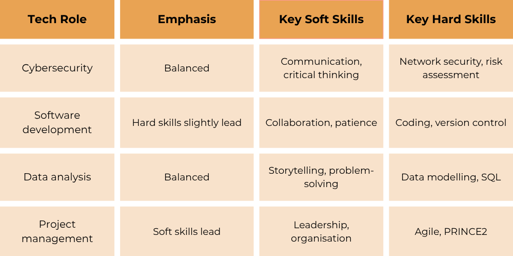
The ideal balance between soft and hard skills depends on your career path. Regardless of your specialism, focusing on both sets of skills sets you apart in the job market, makes you a more competitive candidate for tech roles, and helps you build a resilient, future-ready career:
How We Can Help You Develop Soft Skills
At Learning People, we believe that true career empowerment comes from developing both technical knowledge and human-centric skills. Our Career Pathways are built to equip you with in-demand hard skills and the power skills employers are actively seeking.
All of our courses in IT, project management, cybersecurity, coding and data, are designed to build not only your technical foundation but your confidence, collaboration and communication too. So, if you're wanting to future-proof your career by developing your soft skills this autumn, we can help.
Soft Skills vs Hard Skills in Tech FAQs
Related Articles
 Getting a Job With No Experience
How to Write a Resume for a Job With No Experience
Learn how to write a resume for a job with no experience. Practical tips to highlight skills, training and potential to stand out in entry-level roles.
Read More Getting a Job With No Experience
How to Write a Cover Letter for a Job With No Experience
Learn how to write a confident cover letter for a job with no experience. Use our clear framework to highlight skills, motivation and potential.
Read More Changing Career
The Best Career Pivots for Educators: How to Change Careers from Teaching
Teachers and educators will find that their skillsets are in high demand in other sectors. Learn more about how to change careers from teaching and which new roles might be a good fit.
Read More Changing Career
How to Change Career at 50: The Steps and Advantages of a Later-in-Life Career Change
If you’re 50 and thinking about changing careers, let me reassure you – it’s not too late. In fact, it might be the perfect time. Read on to learn more about why and how to change careers in later life.
Read More