

The digital landscape of 2026 is powered by seamless, high-performing applications, and at the heart of this evolution is the Full Stack Developer.
As businesses shift toward AI-integrated platforms and cloud-native solutions, the demand for versatile developers who can handle both the "face" and the "brain" of an application has skyrocketed. Recent industry data shows that Full Stack roles remain among the most resilient in tech, with a projected job growth of 25% over the next decade.
This article provides the definitive blueprint for landing this role. We will outline exactly what a Full Stack Developer does, the essential 2026 certification roadmap, and the actionable steps you need to take to become a highly employable full stack professional, even if you are starting with zero technical knowledge.
Written by
With four years at Learning People and a solid foundation in IT and Cybersecurity, Chris guides people through the fast-evolving tech landscape and into their dream jobs. He combines hands-on technical expertise with insider industry insights to help learners make informed career decisions.

1. What is a Full Stack Developer?
A Full Stack Developer is a versatile software professional capable of handling both Frontend (what the user sees) and Backend (how the data works) development.
They bring immense value to a business by bridging the gap between user experience and server-side logic, allowing companies to build, deploy, and maintain complex digital products with greater efficiency and fewer communication silos.
This is a role that spans multiple seniority levels. While it is a popular target for entry-level developers coming out of bootcamps or CS degrees, many professionals work toward it after starting in a specialized front-end or back-end role to broaden their architectural expertise.
Is Full Stack Dev an entry-level role?
While "Full Stack" sounds like a senior title, it is a highly accessible entry-level career path.
Many developers start as "Junior Full Stack Developers" by mastering a specific stack (a combination of technologies like JavaScript, React, and Node.js). Because you understand the "big picture" of how an app works, you are often more hirable than someone who only knows one side of the coin.
What does a Full Stack Developer do? Core responsibilities
A Full Stack Developer designs, develops, and maintains the complete architecture of web-based applications. They ensure that a website not only looks professional and responsive but also functions securely and efficiently behind the scenes.
-
End-to-End Feature Development: Designing user-facing elements and then writing the server-side logic required to make those elements functional.
-
Database Management: Architecting and maintaining databases to ensure data is stored efficiently and can be retrieved quickly.
-
API Integration: Building and consuming Application Programming Interfaces (APIs) to allow different software systems to communicate.
-
UI/UX Implementation: Translating design wireframes into high-quality code, ensuring a responsive experience across all devices.
-
Security & Optimisation: Identifying vulnerabilities in the code and optimising the application for maximum speed and scalability.
Day in the life of a Full Stack Developer
Daily life for a Full Stack Developer is a balance of deep focus and team collaboration. Here is what a typical day looks like:
-
The Daily Scrum: Meeting with the product and engineering teams to discuss progress, "sprint" tickets, and any technical blockers.
-
Frontend Development: Spending the morning building or refining UI components using frameworks like React, Vue, or Angular.
-
Backend Engineering: Shifting to server-side tasks, such as writing logic in Node.js, Python, or Java to handle user data or authentication.
-
Code Reviews: Reviewing peer pull requests to ensure the codebase remains clean, bug-free, and consistent with company standards.
-
Testing & Deployment: Writing automated tests and deploying code to staging environments to ensure a smooth transition to production.
What is a Full Stack Developer’s salary?
The average salary for a Full Stack Developer in the UK typically falls between £35,000 and £75,000 per year. Entry-level juniors usually start around £30,000–£40,000, while senior-tier engineers and those based in London or working with high-demand tech stacks can command salaries well in excess of £90,000.
2. Certifications You Need to Become a Full Stack Developer
Recruiters in 2026 use certifications as a benchmark for professional competency. In a competitive digital economy, these credentials act as a "seal of approval," proving you have been vetted against industry standards and possess the practical skills to deliver high-quality code.
Without these, even candidates with a strong portfolio can struggle to pass through automated HR filters. We recommend a tiered approach to validation, ensuring you have the right proof of skill at every stage of your career transition.
| Level | Recommended Certification Path | Professional Value |
| Foundation | IT Foundation Skills | Essential for those starting from scratch. It establishes the "digital literacy" needed to understand how hardware, software, and networks interact. |
| Entry-Level | Front End Plus | Focuses on the "face" of the web. This validates your mastery of HTML, CSS, and JavaScript, marking you as a specialist in user interface (UI) development. |
| Professional | Full Stack Developer Diploma | The industry gold standard for career changers. This comprehensive credential proves you can build both frontend and backend systems from the ground up. |
| Advanced | Data Analyst to Data Scientist | For developers looking to lead in 2026. This path validates your ability to integrate AI, machine learning, and complex data models into your applications. |
For those serious about working their way into this role, we offer a complete full stack course program that includes all the certifications you need to be hired for this title.
3. Key Skills Required for a Full Stack Developer
To become an employable professional, you need a balanced "stack" of technical expertise and human-centric soft skills.
Here is what you need to master and, more importantly, how to actually develop these competencies.
Technical & Hard Skills a Full Stack Dev Needs
-
JavaScript/TypeScript: Mastery of the industry-standard language that powers both the frontend (React) and the backend (Node.js).
-
How to develop: Start by building small, interactive components like image sliders or calculators using "vanilla" JavaScript. Once comfortable, move to a structured training program that introduces TypeScript to learn how to catch errors before your code even runs.
-
-
Version Control (Git): The ability to manage code changes and collaborate with global teams using platforms like GitHub.
-
How to develop: Make it a habit to "commit" your code to GitHub every single day, even for tiny projects. Practice creating "branches" to test new features and then merging them back into your main project to simulate a professional team environment.
-
-
Database Literacy: Understanding how to structure data using SQL (relational) or NoSQL (document-based) systems.
-
How to develop: Practice by designing a "schema" (a blueprint) for a simple app, like a library or a shop. Use tools like MongoDB Atlas or MySQL to practice writing queries that fetch, update, and delete information from your database.
-
-
Cloud Deployment: Knowledge of how to host and manage applications on platforms like AWS, Azure, or Vercel.
-
How to develop: Take a project you’ve built locally and attempt to go "live" with it. Start with user-friendly platforms like Vercel or Netlify, then progress to setting up a virtual server on AWS to understand the infrastructure that powers the modern web.
-
Core Soft Skills a Full Stack Dev Needs
-
Critical Problem Solving: Using "first-principles" thinking to track down a bug in thousands of lines of code.
-
How to develop: When your code breaks, resist the urge to immediately copy-paste the error into a search engine. Instead, use "rubber duck debugging"—explaining your code line-by-line to an object (or friend) to find the logical gap yourself.
-
-
Adaptability: The ability to learn a new framework or AI tool quickly as the tech stack evolves.
-
How to develop: Dedicate one hour a week to "Horizon Scanning." Try out a new CSS library or an AI coding assistant (like GitHub Copilot) on a throwaway project to stay comfortable with the feeling of being a beginner in a new tool.
-
-
Empathy for the User: Understanding that code is a tool to solve a human problem, ensuring the final product is intuitive and accessible.
-
How to develop: Perform a "blind test" on your projects. Ask a non-technical friend to try and use your app without any instructions; watching where they get frustrated or confused is the fastest way to build an intuitive "user-first" mindset.
-
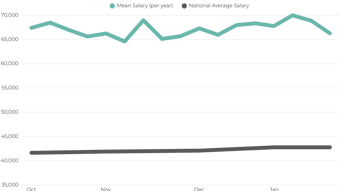
Did you know? Full stack and software developers earn above the national average salary
The mean UK salary for software development roles for October 2025 to January 2026 was £66,566, which is 56.8% above the national average.
Despite an incline at the very beginning of 2026, mean salaries for data roles consistently exceed the national average.
4. The Roadmap: How to Become a Full Stack Developer (Step-by-Step)
Breaking into development requires a tactical approach. You aren't just learning to code; you are learning to build products.
Step 1: Industry Research & Tech Stack Selection
Don't try to learn every programming language. In 2026, the most employable path for beginners is the MERN Stack (MongoDB, Express, React, Node.js). Research local job boards to see if companies in your area prefer JavaScript or C#/.NET. Choose one path and stick to it to avoid "tutorial hell."
Step 2: Master the Fundamentals
Before jumping into complex frameworks, you must master the "Holy Trinity" of the web: HTML5, CSS3, and JavaScript. You should be able to build a static webpage that looks good on a phone and a desktop before you touch a database.
Step 3: Earn Your Professional Validation
Enroll in a structured training program that leads to the certifications mentioned above. This provides the "academic" weight your CV needs to pass through Automated Tracking Systems (ATS). While you study, focus on TypeScript, as most professional companies now require it for its ability to catch errors early.
Step 4: Build a "Proof of Work" Portfolio
Employers don't hire you for what you know; they hire you for what you can build. Create a GitHub profile and host at least three distinct projects:
-
A Frontend Project: A highly interactive dashboard using React.
-
A Backend Project: A custom API that handles user data or file uploads.
-
The "Full Stack" Project: A complete application (like a mini-social network or an e-commerce store) that connects the two.
Step 5: Tactful Rebranding & The "Bridge" Job
Update your LinkedIn to reflect your new identity. Instead of "Aspiring Developer," use "Junior Full Stack Developer | React | Node.js | Azure." If landing a developer role immediately feels difficult, look for "bridging" roles like Junior QA Tester, Technical Support Engineer, or Web Content Manager. These roles get you inside a tech company where you can eventually "pivot" into the dev team.
Conclusion: What’s my next move for becoming a Full Stack Developer?
The transition from a career-changer to a professional developer is a marathon of consistency, not a sprint of intensity. Your next step is to look at current job descriptions for "Junior Full Stack Developer" roles on LinkedIn or Indeed. Take note of the specific libraries and tools they mention—such as Tailwind CSS or Next.js—and plan your learning roadmap around those specific needs.
Becoming a developer in 2026 is about more than just syntax; it’s about proving you can solve business problems with software. Our expert career consultants can help you navigate this entire journey—from choosing the right certification pathway to polishing your portfolio and acing the technical interview.
Ready to start your journey?