

To get into coding, you usually need to learn the fundamentals of programming, choose a practical route such as web development or software development, build real projects, and show employers that you can write, test, and explain working code.
Coding continues to be one of the most practical routes into tech, especially for people who enjoy solving problems and building things from scratch. It is also a career area with strong earning potential across Australia and New Zealand: A recent job market report states that Full-Stack Developers earn $110,000 to $130,000 in Australia and $105,000 to $120,000 in New Zealand.
There is a clear need for people who can do more than understand coding theory. Employers in 2026 are actively searching for junior developers who can build working features, test their own code, fix problems, improve what already exists, and use AI tools sensibly without relying on them blindly.
In this guide, I’ll explain what coding careers involve, the main routes you can take, which skills and certifications you should consider, and the steps you can follow to become employable from a beginner starting point.
Written by
Adam is a Senior Career Consultant at Learning People, specialising in helping people move into IT, Project Management, Cyber Security, Software Development, and Cloud Computing roles through personalised 1:1 consultation. He understands well which skills and certifications employers value most in today’s fast-evolving tech landscape.

What’s the fastest way into a Coding career?
Our Full Stack Developer Course Diploma is a practical route for people who want to build the skills needed for coding roles in 2026. It covers both the front-end parts users see and the back-end systems that power websites and applications behind the scenes, giving you a broader base to work from.
Key qualification: Build a recognised full-stack development diploma that supports your move into junior developer, web developer, or software development roles.
Career support: Get help with your resume, LinkedIn, applications, portfolio presentation, and interview preparation so you can show your coding skills clearly.
Visit our Full Stack Developer Course Diploma page to learn more about the programme and its pricing.
1. What Is a Coding Career, and What Does It Look Like?
Coding is the career in which people use programming languages to build, test, improve, and maintain websites, apps, software, and digital systems. In simple terms, coders write the instructions that tell digital products how to work.
Coding is not one single job title. It can lead into front-end development, back-end development, full-stack development, software development, app development, automation, testing, and later routes such as DevOps or technical leadership.
That is one of the reasons coding can be such a flexible route into tech. You can start small, build practical evidence, and then shape your career around the type of work you enjoy most.
What does a career in coding involve?
A career in coding involves writing code, testing it, fixing errors, and working with other people to turn ideas into usable digital products. In early roles, the focus is usually on smaller, well-defined tasks rather than owning a whole system by yourself.
Common tasks include:
-
Writing code: Building pages, features, functions, scripts, or application logic using languages such as JavaScript, Python, HTML, CSS, or Java.
-
Testing and debugging: Checking that code works as expected, finding errors, and fixing problems when something breaks.
-
Version control: Using tools like Git and GitHub to track changes, collaborate with others, and manage code safely.
-
Working from requirements: Turning user stories, tickets, designs, or business needs into practical technical solutions.
-
Improving existing code: Updating older code, improving performance, adding features, and making systems easier to maintain.
The main disciplines in coding
Coding covers several career routes, which means you can choose a path based on what you enjoy building and how you like to solve problems.
|
Discipline |
Focus |
What it looks like in practice |
|
Front-end development |
Building what users see and interact with |
Creating website pages, layouts, forms, buttons, navigation, and interactive features using HTML, CSS, and JavaScript. |
|
Back-end development |
Building the logic behind digital products |
Working with servers, databases, APIs, user accounts, payments, and the parts users do not see. |
|
Full-stack development |
Working across front-end and back-end |
Building both the user-facing side and the behind-the-scenes logic of websites or applications. |
|
Software development |
Creating applications, tools, or systems |
Building software for businesses, customers, internal teams, devices, or platforms. |
|
App development |
Building mobile or web applications |
Creating apps for phones, tablets, browsers, or connected services. |
|
Testing and QA automation |
Checking that software works properly |
Writing tests, finding bugs, checking user journeys, and helping teams release better-quality code. |
Progression in coding careers
Coding careers often start with junior development or support-adjacent roles before moving into more specialist, senior, or leadership positions.
A typical pathway can look something like this:
-
Entry-level: Trainee Developer, Junior Web Developer, Junior Software Developer, QA Tester
-
Junior level: Front-end Developer, Back-end Developer, Junior Full-stack Developer, Software Developer
-
Mid-level: Full-stack Developer, Software Engineer, Automation Engineer, Application Developer
-
Senior level: Senior Developer, Senior Software Engineer, Technical Lead
-
Management or architecture: Engineering Manager, Solutions Architect, Software Architect
-
Leadership: Head of Engineering, Director of Engineering, CTO pathway
Can coding be an entry-level career?
Yes, coding can be an entry-level career, but I’d be careful about what “entry-level” really means. It does not mean employers expect you to know nothing. It means they expect you to be early in your career, with enough evidence to show you can learn, solve problems, and build working code.
You do not always need a computer science degree, but you do need proof. That could be a small portfolio, a GitHub profile, coding projects, structured training, or examples from a support, QA, digital, or technical role where you have started using code.
My advice is to avoid hiding behind “I’m a beginner”. Show the work instead. Even a simple project is useful if you can explain what you built, what broke, how you fixed it, and what you would improve next.
2. What Skills and Certifications Are Needed for a Career in Coding?
A career in coding needs a mix of programming skills, problem-solving ability, practical project experience, and recognised training or certifications. You can build all of this step by step, even if you are starting from a completely different background.
Foundational skills: The hard skills
-
Programming fundamentals: Understanding variables, functions, loops, logic, data structures, and how code is organised gives you the base for every coding route.
-
HTML, CSS, and JavaScript: These are key starting points for web development because they control the structure, style, and interactivity of websites.
-
Python or Java: Python is useful for general programming, automation, back-end basics, and data-adjacent work. Java is often used in larger software systems and enterprise environments.
-
Git and GitHub: Version control helps you track changes, collaborate with others, and show employers your project work.
-
Testing and debugging: You need to know how to find errors, read error messages, test your work, and fix problems without guessing wildly.
-
Basic database knowledge: Many applications store information, so it helps to understand how data is created, saved, retrieved, and updated.
Critical soft and human skills
-
Problem-solving: Coding is often about breaking a problem into smaller steps and working through them logically.
-
Patience: Code breaks. Sometimes because of one tiny typo. Staying calm is a skill in itself.
-
Communication: You need to explain what you built, ask good questions, and translate technical issues for non-technical people.
-
Attention to detail: Small mistakes can create big problems, so accuracy matters.
-
Curiosity: Languages, frameworks, and AI tools change quickly, so you need to keep learning without feeling like you must know everything already.
The certification roadmap
Coding certifications give your learning structure and help employers understand your skill level more quickly. If you are a beginner I would recommend going in this order:
The certifications and training route you choose should match the kind of coding career you want to build. For example, front-end training can suit you if you want to create websites and user-facing features, while Python, Java, full-stack development, or software testing courses can support different routes into development, automation, QA, or back-end work.
Our coding training can be shaped around your starting point, your goals, and the skills employers are likely to expect for your chosen path. You’ll also get learning support, career guidance, resume and LinkedIn support, and help preparing for applications and interviews.
You can visit our dedicated coding courses page to explore the options in more detail, or use the button below to request a free consultation with one of our career advisors.
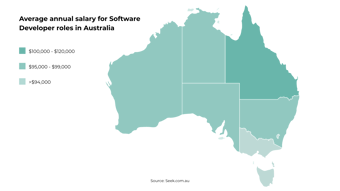
Did you know? Coding professionals earn above the national average salary
The average annual salary for coding and software development roles in Australia ranges from $80,000 to $100,000. It's even higher in New Zealand, ranging from $100,000 to $105,000.
Find more coding job market insights in our frequently updated industry mini-report.
3. How Do I Break Into Coding? The Step-by-Step Sequence
To break into coding, start by choosing a realistic route, learning the fundamentals, getting certified, building small projects, creating a portfolio, and applying for junior or bridge roles where you can keep improving.
Step 1: Choose the coding route that fits your goals
The first step into coding is to choose your route, such as front-end development, back-end development, full-stack development, software development, or testing and QA.
Start by looking at real job adverts. Search for roles like Junior Developer, Junior Front-end Developer, Junior Software Developer, Web Developer, Trainee Developer, Junior Full-stack Developer, QA Tester with coding, or Technical Support with scripting.
You will start to see patterns. Front-end roles focus on what users see and click. Back-end roles focus on the logic, databases, and systems behind the scenes. Full-stack roles combine both. Testing and QA roles can suit people who enjoy spotting problems and improving quality. This will help you spot which coding roles interest you most and what employers are actually asking for at entry level.
Step 2: Learn the coding fundamentals properly
The second step is to learn programming fundamentals before jumping into too many frameworks or shortcuts. Frameworks change, but the basics stay with you.
Focus on variables, functions, loops, conditional logic, arrays, objects, errors, APIs, basic data storage, and Git basics. For many beginners, HTML, CSS, JavaScript, and Python are practical starting points because they let you build visible projects fairly quickly.
This is the stage where slow and steady really does win. If you understand why your code works, not just what to copy and paste, you will have a much stronger base for junior roles.
Step 3: Gain relevant training or certification
The third step is to choose structured training or certifications that match the type of coding career you want to build. This shows employers you have taken a clear and credible learning path.
At this stage, it helps to think about the kind of work you want to do day to day. If you enjoy visual, user-facing work, a front-end training route makes sense. If you prefer logic, systems, and problem-solving behind the scenes, Python, Java, or full-stack training may be a better fit. And if you like spotting issues and improving quality, software testing can be a strong way into the industry.
Certifications are useful, but they should not be your only proof. Pair them with projects, GitHub evidence, and clear explanations of what you have built.
Step 4: Build projects that prove you can use the skills
The fourth step is to build small coding projects that show you can apply what you are learning.
You could build:
-
A personal portfolio website
-
A to-do list app
-
A budget calculator
-
A weather app using an API
-
A simple booking form
-
A Python script that automates a repetitive task
-
A small full-stack app with a database
For each project, write a short note explaining what you built, which tools you used, what went wrong, and what you would improve next. That last part is important, as it shows employers your problem-solving skills.
Step 5: Rework your Resume, LinkedIn, and applications around evidence
The fifth step is to update your resume, LinkedIn, and applications so they show what you can actually do. For coding roles, evidence is very important.
Add your projects, GitHub link, portfolio site, technical skills, certifications, and target role. If you are changing careers, translate your existing experience into coding-relevant strengths. Customer service can show communication and user empathy. Admin can show accuracy and process thinking. Sales can show understanding user needs. Operations can show workflow and problem-solving.
Then apply for junior roles and bridge roles that match the route you are working towards. For example, that might mean:
-
Front-end development: Junior Front-end Developer
-
Software development: Junior Developer
-
Full-stack development: Junior Full-stack Developer
-
Testing and QA: QA Tester
-
Technical support route: Technical Support with scripting
-
Website and content systems: CMS Assistant
-
Data-adjacent route: Data Support Assistant
These roles can help you get closer to coding work while you keep building your skills, projects, and confidence.
Conclusion: What’s My Next Move for Breaking Into Coding?
Your next move for breaking into coding is to research the different career routes, choose the path that fits your goals, and start building the skills employers expect to see in junior roles.
That usually means learning the programming basics, choosing relevant training or certifications, and building small projects that prove you can use what you have learned. Your portfolio does not need to be perfect. It needs to show progress, problem-solving, and practical effort.
At Learning People, we can help you make sense of the different coding pathways, from front-end and full-stack development to Python, Java, and software testing. We also support learners with structured training, career guidance, resume and LinkedIn support, portfolio advice, and help through the application and interview process.
If you want help choosing the right route into coding, you can enquire to speak with one of our career advisors.