

PRINCE2® vs PMP: Which Should I Do?
Compare PRINCE2® against the PMI Project Management Professional (PMP) certification in this article. See the key differences, entry requirements, timelines, and which qualification offers the strongest long-term value.

PRINCE2® is usually the first qualification people hear about in the UK, and it’s easy to see why. It’s been around for years and still pops up in plenty of job ads. But that familiarity often leads people to assume it’s the automatic choice, and that isn’t always true.
By the time someone reaches out to us, they usually know both PRINCE2® and the PMP by name, yet they’re unsure which one genuinely fits where they want to go next.
My focus here will be walking you through the real differences between PRINCE2® and PMP qualifications, what each one prepares you for, and the type of learner or career stage they’re best suited to. The team of project management career consultants I manage at Learning People speak to people regularly who are weighing up these two options. My aim here is to make the decision feel clearer and far less overwhelming.
And if you need to take a step back, you can revisit the foundations of what project management is in our dedicated guide.
Written by
With over a decade of experience in project management education and industry, Matt has become our in-house expert. Matt is an Enrolment and Growth Manager at Learning People, consistently helping students to advance their careers through learning and certification.

A Simple Explanation of PRINCE2® and PMP
PRINCE2® and the PMP often get mentioned in the same breath, but they come from very different worlds.
- PRINCE2® was developed in the UK and built around a structured, process-heavy approach. It’s long established, easy to recognise, and still used in plenty of organisations. At the same time, it can be a little rigid for fast-moving or tech-focused environments where teams adapt their plans daily. The first course is the PRINCE2® Foundation.
- The PMP certification takes a different path. It’s an international certification centred on real project experience, practical judgement, and the broader competencies laid out in the PMBOK. When I speak to people who’ve worked across multiple industries, they tend to describe the PMP as a better reflection of what their day-to-day work actually looks like.
The biggest difference between the two is how well they suit the environment you want to work in, and how much experience you already bring.
If you’re wondering how to become a Project Manager and you’re right at the beginning of that journey, that context matters more than people realise.
Over the next sections, I’ll break down what each route involves so you can match the qualification to your long-term goals rather than the most familiar name.
Fact: Certifications Are Becoming More Important as Projects Grow More Complex
UK employers are placing greater emphasis on formal project management certifications as project complexity increases.
Rather than relying solely on informal experience, many organisations now expect recognised credentials to ensure consistency, capability, and structured decision-making across teams. This shift is particularly clear in sectors dealing with digital transformation and large-scale change.
Entry Requirements and Prerequisites
The entry criteria for PRINCE2® and the PMP tend to steer learners in very different directions.
PRINCE2®
PRINCE2® is open to everyone.
-
No prerequisites
-
Start with Foundation, then move on to Practitioner
Because of this, people at the very beginning of their journey often gravitate toward it. If you’re still working out how to become a Project Manager, PRINCE2® can feel like a straightforward first step you can move through quickly.
PMP
To become a certified PMP, you need a bit more experience before you study for and take the exam.
-
Documented project experience
-
Verified project hours
-
Formal training requirements
When I speak to learners who’ve been managing projects without the official title (team leads, operations staff, coordinators who’ve stepped into responsibility by necessity), the PMP usually clicks. They already have the real-world experience; they just need a qualification that validates it.
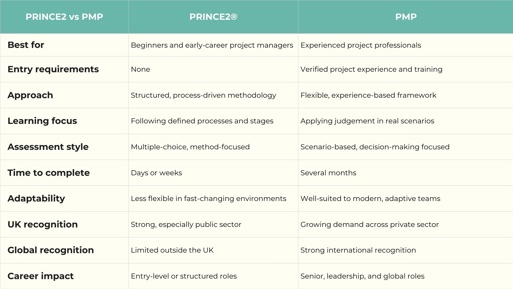
These entry requirements naturally sort people based on where they are in their career: PRINCE2® suits beginners, while the PMP typically fits those already operating at a certain level of competency.
What You Learn and How You’re Assessed
When people ask me what the actual learning experience feels like, the contrast between the two qualifications becomes even clearer.
PRINCE2®
PRINCE2® follows a linear, method-driven structure. You learn the defined processes, understand the terminology, and apply the method step by step. It’s strong on governance and clear documentation, but it can feel less adaptable if you’re working in environments where plans change quickly.
The assessment reflects this. The Practitioner exam is mostly multiple-choice and focuses on how well you can recall and apply the established methodology. If you like structured rules and a clear framework to follow, this approach can be reassuring.
PMP
The PMP casts a wider net. You’re taught to think across people, processes, and business considerations, and a lot of the learning is rooted in real scenarios. It’s designed to test your judgement when things are uncertain.
In terms of the exam, you’re assessed on how you think, not just what you remember. In many ways, the PMP mirrors modern working styles where adaptability, communication, and problem-solving matter just as much as process.

How Long They Take to Complete
Time is a big factor for most people I speak to, and the difference between these two routes is pretty noticeable.
PRINCE2®
PRINCE2® is quick. Most learners move through Foundation and Practitioner within a few days or weeks, depending on how they study. That speed is appealing if you want a recognised qualification on your CV as soon as possible. I’ve worked with plenty of people who were under pressure to upskill fast, and PRINCE2® gave them a clear, short path to follow.
PMP
The PMP takes longer, and that’s partly the point. You need the documented experience, the formal training, and the application approval before you sit the exam. Preparing properly usually takes months. The upside is that this longer process often leads to deeper learning, especially for people who’ve already handled projects and want a qualification that matches their level.
Quick isn’t always better. It depends on your goals. If you’re weighing up different study routes, exploring our project management courses can help you map out realistic timelines for both paths.
Fact: Project Management Is Now Seen as a Core Function Across Major UK Industries
A UK parliamentary research submission highlights that project professionals play an increasingly central role in priority sectors such as technology, infrastructure, business services, and national-level change programmes.
As organisations take on more complex work, structured project management is no longer seen as optional: it’s becoming foundational to delivery and growth.
Recognition in the UK and Globally
This is usually the point in the conversation where people lean in a little, because recognition can shape the opportunities you see later on.
PRINCE2®
PRINCE2® is still highly visible in the UK, especially across the public sector and certain consultancies. Many learners tell me they see it mentioned often in job ads, particularly in more traditional or process-heavy environments. That visibility can make it feel like the “safe” choice, and in some contexts, it genuinely is.
PMP
The PMP, however, is becoming the qualification employers look for when they want someone who can handle real-world complexity.
More adaptive teams, digital projects, and cross-functional organisations tend to value the broader skill set the PMP reflects. I hear this a lot from learners already working in fast-paced industries — their hiring managers look for capability, not just methodology.
There’s also clear evidence that the UK project management job market is expanding. Our project management job market insights report, based on Adzuna Intelligence data, shows more than 128,000 unique postings for project management-related roles in the first nine months of 2025.
---
Both qualifications are recognised, but in a market that’s growing and becoming more competitive, many now feel the PMP gives them an edge in environments that value adaptability and broader capability, not just process knowledge.
Which One Should You Choose, PRINCE2® or PMP?
This is usually the point where people want a straight answer, and I try to keep it as clear and honest as possible.
When PRINCE2® Makes Sense
PRINCE2® is a good fit if you:
-
need something you can complete quickly
-
are aiming for roles in UK public sector organisations or structured consultancies
-
want a baseline qualification that helps you enter the field
You may simply need a recognised starting point, and PRINCE2® does that well. It’s familiar, accessible, and gives you a method to follow.
When the PMP Is the Better Choice
The PMP suits you if you’re aiming for:
-
long-term career progression
-
global mobility
-
modern, adaptive project environments
-
leadership or senior roles
A lot of employers see the PMP as a signal of deeper capability, because it reflects judgement, experience, and the ability to operate beyond a fixed methodology. If you’re curious about how technology is changing the role, or how tools like AI for project management are shaping expectations, the PMP aligns more naturally with that direction of travel.
My Take
Both routes have value, but if I look at the career stories people share with us, the PMP tends to open more doors over the long term. It’s becoming the more future-proof choice, especially if you want flexibility and room to grow as the profession evolves.
Final Thoughts
If you’re still weighing things up, you’re not the only one. At Learning People, we help hundreds of people make this exact decision every week, and it’s completely normal to feel unsure at first.
PRINCE2® is widely known and still useful in the right settings, but the PMP tends to offer stronger long-term value, especially for those thinking about growth, adaptability, and future opportunities.
If you’d like tailored advice, you can always book a free call with one of our career experts and talk through what fits your goals best.