
How to Prepare for a Job Interview (Including for a Career Change)
Learn how to prepare for a job interview, including online and career-change interviews, with practical advice from an experienced career advisor.

For many people, the thought of an interview makes them more nervous than any other part of their job search. Interviews can feel unpredictable, especially if you have not done one in a while, or if you are stepping into a new field.
The good news is that interview performance is not about luck or natural confidence: it is a skill. And like any skill, it improves with the right preparation.
At Learning People, we see this first-hand. As a career advisor, I've learnt that candidates who do the best are not necessarily the ones with perfect backgrounds. They are the ones who take time to prepare, reflect, and treat interviews as part of their wider continuing professional development.
In this guide, I will walk you through practical ways to prepare for job interviews so you can show up calm, clear, and confident. We will cover standard face-to-face interviews, how to prepare for online interviews, and what to focus on if you're changing careers this spring.
Written by
Kirsten has worked in career development, recruitment, and people-focused roles for several years. She knows what it’s like to navigate career change and to search for a role that's more aligned with your goals; she's proud of the work she does to help our customers develop the tools, mindset, and confidence to land jobs they’re proud of.

What's on this page?
Jump to:
- Understand What the Interview Is Really Assessing
- Research the Role, Company, and Industry
- How to Prepare for Common Interview Questions
- Preparing for Online and Remote Job Interviews
- What to Wear and How to Present Yourself
- Questions to Ask the Interviewer
- How to Prepare for Career-Change Interviews
- Talking About Salary and Expectations (If It Comes Up)
- After the Interview: What to Do Next
- How to Prepare for a Job Interview FAQs
1. Understand What the Interview Is Really Assessing
It helps to stop thinking of interviews as a test where there is one correct answer. In reality, most interviewers are trying to build a rounded picture of how you would show up in the role and within their team.
From our side, and from what employers consistently feed back to us, four things usually matter most:
-
Capability: Can you do the work, or do you show clear signs that you can grow into the role quickly?
-
Attitude: How do you respond to challenges, learning curves, and feedback?
-
Communication: Can you explain your thinking clearly and listen well?
-
Potential: Particularly in tech and project management roles, many hiring decisions are based on where you could be in six or twelve months, not just where you are today.
Preparation is what ties all of this together. Turning up informed, thoughtful, and ready to engage shows professionalism before you even answer your first question.
2. Research the Role, Company, and Industry
I always encourage candidates I'm working with to start by researching the role itself. Look closely at the responsibilities and think about how the day-to-day work is likely to look in practice.
Then step back and consider the company. Where are they heading, and what do they seem to care about right now?
Recent news, product updates, or changes in leadership can all offer useful context. If you can, get a sense of the team or department, too. Understanding how the role fits into the wider business helps you frame your answers more naturally.
For the interview, be prepared to talk about how your working style connects to their mission and the direction they're taking. My colleague in the Career Services Team at Learning People had an idea of how you can use this to your advantage in an interview situation:
Tip: Ask questions about the company's direction, challenges, and opportunities...
This can help you better understand what kind of people they're looking to employ, and gives you the chance to directly link this kind of profile to your own professional attributes.
For example, if they say they want to build an innovative team that develops new concepts and boldly treads new ground, you can give examples of when you've demonstrated creative thinking or contributed new ideas in your previous jobs (even if these examples are from your work in a different type of role or sector).
I'll speak more about what questions to ask in the interview later in the article.
Fact: UK Employers Prioritise Soft Skills as Much as Qualifications
A survey found that 67% of UK employers value soft skills as much as they value formal qualifications when assessing candidates.
This highlights how communication, teamwork, and adaptability often carry more weight in interviews than credentials alone. Interview preparation should focus just as much on how you explain your thinking and work with others as on technical knowledge.
3. How to Prepare for Common Interview Questions
Employers use familiar questions to benchmark candidates. Since you know what’s coming, you shouldn't just wing it. Preparation is the process of translating your history into their solutions.
Build Your "Story Bank"
Instead of memorising scripts, curate 5–7 "power stories" from your career. A good story is versatile; one example of a difficult project can often answer questions about teamwork, problem-solving, and handling pressure.
The Framework: Use the STAR Method
To keep your stories concise and impactful, map them out using this structure:
-
S - Situation: Set the scene (10% of your answer).
-
T - Task: What was the specific challenge or goal? (10%)
-
A - Action: What you specifically did. Use "I," not "we." (60%)
-
R - Result: The data-driven or qualitative outcome. (20%)
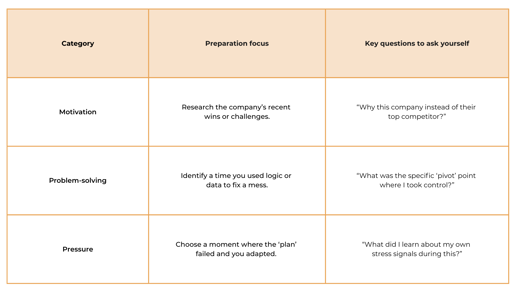
Tailoring Your Prep by Category
Here is how to strategically prepare for the four "pillars" of common interview questions:
The "Vocal Test"
Your brain is a liar—it thinks you’re much more articulate than you actually are. When you "think" an answer, you skip the awkward transitions.
-
Record and review: Use your phone to record yourself answering a prompt. You’ll immediately notice if you use too many "ums" or if your "Action" section is too vague.
-
The mirror check: Watch your body language. If you look terrified while talking about "handling pressure," the interviewer will notice the disconnect.
-
Bullet points, not scripts: Never write out your answers word-for-word. You’ll end up sounding like a robot or, worse, you'll panic if you forget a specific sentence.
Connect the Dots
Finally, look at the Job Description (JD) and highlight the top three skills they want (e.g., "Leadership," "Python," "Client Relations"). Ensure at least one of your STAR stories directly proves you have each of those skills. If you don't have a story for a key requirement, you aren't ready for the interview.
Would you like me to help you draft a STAR response for one of these categories, perhaps using a specific achievement from your own career?
4. Preparing for Online and Remote Job Interviews
Knowing how to prepare for a job interview online is now just as important as preparing for a face-to-face one. While the format is different, the expectations are largely the same. Employers are still assessing how you communicate, how engaged you are, and how seriously you take the opportunity.
Start with the basics:
- Check your tech well in advance.
- Make sure your internet connection is stable.
- Ensure your camera and microphone work properly, and you know how to use the video call platform.
These small checks remove unnecessary stress on the day.
Next, think about your environment. You need:
- A quiet space.
- A neutral background.
- Good lighting to help keep the focus on you rather than what is happening around you.
Try to sit upright, look into the camera when speaking, and allow brief pauses before answering to make your responses feel more natural.

5. What to Wear and How to Present Yourself
I advise dressing in a way that's smart, tidy, and appropriate for the company. If you are unsure, it is better to be slightly more polished than too casual, but it's also okay to confirm the dress code with your point of contact at the company if they haven't shared this already.
- For in-person interviews, think about how you present as a whole. Arriving on time, making eye contact, and offering a clear greeting all shape first impressions just as much as clothing does.
- For online interviews, choose something that looks professional on camera and avoids distractions like loud patterns or overly bright colours.
When you feel comfortable in how you present yourself, it is much easier to focus on your answers and the conversation itself.
6. Questions to Ask the Interviewer
An interview is not a one-way conversation. From an employer’s point of view, thoughtful questions show interest, preparation, and how you think about your future.
Saying you have no questions can sometimes suggest the opposite, even if that is not your intention.
It helps to focus on areas that show you are thinking beyond day one. Useful themes include:
- how the team is structured
- what success looks like in the first few months
- how priorities are likely to change over time.
Asking about expectations can also help you understand how performance is measured and supported.
Progression is another sensible topic to explore. Framing questions around learning, responsibility, and career progression development shows that you are thinking about growth and commitment, not just the role itself. Well-chosen questions often leave a strong final impression.
Fact: Technical Issues Are Common in Online Interviews
Research shows that 62% of candidates experience technical problems during virtual interviews, from audio issues to unstable connections.
This underlines why online interview preparation goes beyond rehearsing answers. Simple steps like testing your setup and platform in advance can prevent avoidable disruptions and help you stay focused and confident.
7. How to Prepare for Career-Change Interviews
Changing career adds an extra layer to interview preparation, but it does not have to be a disadvantage. In many cases, employers are open to career changers. They just want reassurance that the move makes sense and that you are prepared for what comes next.
Addressing the Career Change Head-On
Interviewers usually ask “why the change” because they want to understand motivation and commitment, not because they doubt your decision. A clear, honest answer goes a long way. I often suggest keeping this part simple. Explain what drew you to the new field, what you have learned so far, and why this role feels like a logical next step. Avoid over-defending the choice.
Translating Transferable Skills
One of the most important parts of a career-change interview is helping the interviewer see how your existing experience still applies. In the age of AI, soft skills carry real weight, so be sure to highlight your ability to plan, communicate, problem-solve, and manage stakeholders. The key is to talk about how you have used these skills in practice, even if the context was different.
Showing Commitment
Employers also look for evidence that you have taken the transition seriously. This might be learning new tools, completing training, or building practical experience alongside your current role. You do not need to list everything.
-
A few well-chosen examples are enough to show intent and preparation. It can sometimes help to look at how others have approached career change. Reading through a few career change CV and cover letter examples can give you ideas on how to frame your experience and decision-making.
8. Talking About Salary and Expectations (If It Comes Up)
Salary often feels like the most awkward part of an interview, but it is a normal topic and one that employers expect to discuss at some stage.
The key again is preparation. Having a realistic sense of market ranges, your current position, and what flexibility you have helps you answer calmly rather than reactively.
You do not need to give a single fixed number straight away, but you should be ready to talk confidently about expectations.
If this is an area you feel unsure about, it can help to think ahead about how to negotiate salary so that, if the question comes up, you respond with clarity.
9. After the Interview: What to Do Next
Once the interview is over, it is worth taking a moment to reflect while it is still fresh.
A short follow-up message thanking the interviewer for their time is always appropriate. Beyond that, think about what went well and what you would handle differently next time. Even when the outcome is not what you hoped for, each interview builds experience.
My final word on interview preparation...
Preparing for an interview does not mean aiming to be flawless. What matters more is showing that you have thought things through, reflected on your experience, and taken the process seriously. I have seen many people perform far better than they expected simply because they prepared calmly and deliberately.
If you're ready to change or boost your career this spring, we are here to help. You can book a free consultation with one of our career experts to get practical, honest guidance tailored to where you are right now.