

How to Prepare for AI’s Impact on the UK Job Market and Careers
The "AI is stealing all the jobs" talk is scary. My best advice: don't panic, prepare. In this guide, I've used current statistics to tell a story of how AI is impacting the UK job market and how you can future-proof your career for this digital revolution.

Even three quarters of the way through 2026, it’s hard to scroll through the news without seeing headlines about AI “taking over” the workplace. I’m sure a lot of the people reading this will have their own concerns and worries about what this means for the future of their career.
However, while it’s true that AI will change the shape of employment, it’s certainly not the job apocalypse some are making it out to be. Yes, some roles will become less in demand, especially those with repetitive, easily automated tasks. But AI is also creating whole new industries and career paths within tech.
We’re already seeing rising demand for roles like Data Analysts, AI Prompt Engineers, Cybersecurity Specialists, and Project Managers. And many existing careers, from teaching to engineering, are likely to remain firmly human-led, even if AI becomes part of the professional toolkits.
What I’m here to tell you in this article: the smartest response to these shifts isn’t panic. It’s preparation. I've analysed the latest data and statistics to help you understand how AI is impacting the job market. Knowing where role demand is shrinking and where it’s growing can help you make informed choices about re-skilling, up-skilling, and positioning yourself for the careers of the future.
Written by
As our Head of Education, Mark is passionate about ensuring Learning People delivers world-class curricula and training for people who want to launch or progress their careers in IT, Coding, and Project Management.

What's on this page?
Jump to:
- How is AI Impacting the UK Labour Market?
- How Many Jobs Will AI Replace in the UK by 2030?
- What Jobs Will AI Create?
- What Jobs Will AI Replace?
- What Jobs Will AI NOT Replace?
- AI is Disrupting the Job Market: How Can You Stay Ahead?
- Final Thoughts: You Decide the Impact of AI on Your Career
- FAQs about AI's Impact on the Job Market
How is AI Impacting the UK Labour Market?
AI is reshaping the UK labour market in ways that are more positive than the “robots will take our jobs” headlines suggest. With Cornerstone’s 2026 Skills Economy Report revealing that demand for AI and machine learning skills has surged by +245% since 2023, and conversations around AI-proof jobs continuing to grow, it can be hard to know where your career fits into this new landscape.
More and more people are using AI to craft their job applications; 43% of UK graduates use AI to edit a CV or cover letter, while 35% admitted to using it to write one from scratch. On the other side of the recruitment process, 56% of recruiters say they often or always receive CVs that contain AI-generated text.
While some roles are evolving or fading, new opportunities are emerging across sectors, often in places you might not expect. In fact, +1.3 million jobs have been created thanks to AI, according to LinkedIn's latest Labour Market Report. Recruitment company Robert Walters also recently reported that the UK could face a shortage of 160,000+ AI professionals by 2028.
The statistics for this section were sourced from leading industry experts and organisations, including the UK government, Amazon Web Services (AWS), Goldman Sachs and more:
1. Employers are asking for AI skills more than ever
With the UK government's most recent AI Labour Market Survey finding that over a third (35%) of organisations are struggling to fulfil AI roles in the UK, the main factors being a lack of work experience (31%) and insufficient technical skills (30%) amongst candidates. This further supports the fact that demand for AI skills is continuing to grow.
The situation is much the same in the private sector, with recent research by AWS finding that nearly half (49%) of UK organisations cite a lack of AI and digital skills as their single biggest barrier to wider AI scaling.
2. Some industries are racing ahead with AI adoption
Sectors like tech, finance, and professional services have all seen big jumps in job ads asking for AI skills. In fact, AI skills shortages have almost doubled the time it takes financial services to fill AI or digital roles, with successful candidates receiving as much as a 49% pay premium.
3. Jobs most affected by AI are not going to vanish
Much of the recent discussion around AI in the UK has focused on its impact on entry-level jobs. Despite the negative press, the Institute of Student Employers (ISE) latest survey highlights that 40% of employers do not expect to replace any entry-level roles with AI. In other words, the entry-level job market hasn't disappeared, but it has changed.
4. Jobs influenced by AI are seeing the fastest skill changes
Roles most affected by AI have had skills requirements shift nearly 60% more than other jobs. Employers are now putting more weight on practical abilities than on degrees – so much so that 64% of HR professionals say a degree alone doesn't guarantee the digital or AI capability modern roles require.
And the big, important headliner statistic here is…
5. AI is being used more to support people than to replace them
In many industries, jobs where AI helps people do their work have grown faster than jobs where AI fully takes over. For example, the +1.3 million new jobs cited by LinkedIn, are due to increased global power demand from data centres (which is predicted to grow by 170% by 2030). This shows that, in most cases, AI is being used to boost human capabilities rather than replace them.
---
The key takeaway from all this, in my opinion? Yes, AI skills are increasingly in high demand and seem to be the key to future-proofing your career reliably. On the other hand, no, AI is not simply replacing jobs like-for-like, it’s supporting people to work more effectively in their roles and changing the skills needed from employees in different fields.
Fact: Over a Third of UK Employees Use AI in the Workplace
According to the most recent data from Hays, 34% of employees report using AI regularly in their workplace. The most commonly cited benefit of AI among employees is increased productivity and efficiency, chosen by 61%.
Notably, Project Managers are leading the way with AI integration in the UK, with a person-centred approach to AI being key to effective AI implementation in project management.

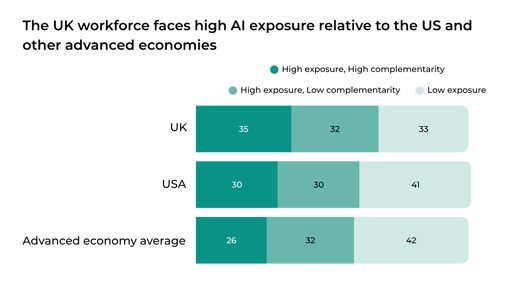
How Many Jobs Will AI Replace in the UK by 2030?
Bold and scary predictions about AI’s impact on jobs grab attention, but the real story is more complex than “there will be fewer jobs because of AI”.
Millions of roles will be touched by AI in some way, yet the scale of change will be shaped by the choices employers and policymakers make – whether they focus on replacement or on reshaping work to pair human skills with AI capabilities.
The IPPR estimates that up to 8 million UK jobs could be at risk if AI adoption focuses purely on automation without safeguards – particularly back-office, entry-level, and part-time roles. The most recent Pearson Lost in Translation report has revealed that by 2030, around 65% of the skills needed for existing jobs will have changed. Women and younger workers, who are overrepresented in these positions, could face the biggest disruption. In a worst-case scenario, this would mean replacing rather than adapting these roles.
However, a more optimistic scenario is equally plausible. The Tony Blair Institute projects that between 1 to 3 million jobs could be displaced by 2030, but not all at once. Annual losses could peak at 275,000, well below the UK’s historic yearly average for job churn. Crucially, this displacement would likely be offset over time by AI-driven economic growth, new industries, and entirely new types of work.
AI is already showing promise in boosting productivity, improving healthcare, and supporting education. It's making changes that are creating more demand for skilled workers. The difference between large-scale job loss and large-scale opportunity comes down to policy, corporate strategy, and upskilling efforts.
The key takeaway here: while AI will certainly change the UK job landscape by 2030, it doesn’t mean we’re simply “losing” jobs. Most will evolve, and millions of new ones will be created for those ready to adapt.
What Jobs Will AI Create?
AI is a growth engine for new careers. As more organisations integrate AI into their operations, they need people who can design, manage, interpret, and ethically guide these systems. This means demand is rising for roles that blend technical expertise with strategic thinking, creativity, and human insight.
We’re also seeing entirely new job categories emerge, from AI trainers who fine-tune models to ethics specialists who set guardrails for responsible use. Many of these careers didn’t exist a decade ago, and most will continue evolving as AI technology advances. The result? More opportunities for those willing to adapt, reskill, and step into AI-enabled roles.
- Data Analysts – demand for AI and big data roles up ~41–46% by 2030. With AI producing ever more data, analysts are crucial for turning that into insights that drive decisions. According to the World Economic Forum, demand for Data Analysts and other big data roles is projected to grow by 41% to 46% by 2030.
- AI/Machine Learning Engineers – 40% growth in job openings by 2027. These engineers design, build, and refine AI systems – everything from language models to predictive tools. The World Economic Forum forecasts a 40% increase in demand for AI and ML specialists by 2030.
- Cybersecurity Specialists – approximately 3.5 million unfilled roles globally. As AI expands, it creates new security risks, which only skilled cybersecurity experts can manage. ISC2 reports about 4.8 million cybersecurity job openings worldwide, revealing urgent demand.
- AI Trainers & Ethics Officers – emerging roles ensuring AI fairness and safety. Companies rely on these professionals to reduce bias, guide model behaviour, and oversee responsible deployment. New job profiles like “AI ethicist” and related roles are already emerging to meet this need.
- Project Professionals (e.g., Digital Project Managers) – 25 million new project management professionals needed globally by 2030. Managing AI projects demands leaders who understand both tech and strategy. The Project Management Institute estimates 25 million new project professionals will be needed worldwide by 2030 – an average of 2.3 million new roles annually.

What Jobs Will AI Replace?
While AI is creating new opportunities, it’s also automating or partially automating roles that rely heavily on repetitive, predictable tasks. These jobs tend to have clearly defined processes, low variation, and outcomes that can be replicated by algorithms or software with minimal human oversight.
It’s important to remember that automation doesn’t always mean outright elimination. Widespread fear of an 'AI jobs apocalypse' is still unfounded according to the newest data and statistics from The Brookings Institution: many roles will transform rather than vanish.
As some tasks are taken over by machines, human workers often move into related positions that require more problem-solving, emotional intelligence, or strategic thinking.
1. Data Entry Clerks
AI-powered data processing can handle vast quantities of information with higher speed and accuracy. Many will shift into data verification or analysis roles that require human judgement.
2. Telemarketers
AI chatbots and automated calling systems can now handle high volumes of sales outreach. Workers may transition into customer success or relationship management roles that focus on deeper engagement.
3. Basic Bookkeepers
Accounting software with AI integration is automating routine ledger work. Bookkeepers are increasingly moving into financial advisory or compliance-focused roles.
4. Proofreaders
Advanced grammar and style-checking tools reduce the need for manual proofreading. Professionals in this field may shift towards content editing or brand voice consultancy.
5. Bank Cashiers
Digital banking and AI-driven kiosks are replacing many in-branch transactions. Former cashiers are finding roles in financial planning or digital client onboarding.
6. Routine Legal Assistants
AI can now draft contracts, review case law, and organise files. Legal assistants may pivot to paralegal work that involves complex case preparation or client liaison.
---
AI replacing routine work isn’t the end of the story; it’s the start of a reshaping process. The key is moving from roles focused purely on execution to ones where human insight adds value that AI can’t replicate.
What Jobs Will AI NOT Replace?
Some jobs are naturally “AI-proof” because they rely on qualities machines can’t replicate. At least not fully. Roles that require deep empathy, complex physical dexterity, nuanced judgement, or creative vision are far harder to automate. Even where AI tools are introduced, they tend to enhance rather than replace the human touch.
These roles often depend on interpersonal connection, ethical decision-making, or hands-on expertise that can’t be reduced to an algorithm. In most cases, AI will become a supportive tool, freeing up time for the human aspects of the job to shine even more.
1. Nurses and Healthcare Practitioners
Direct patient care requires empathy, adaptability, and trust-building – qualities AI cannot authentically replicate. AI may assist with diagnostics or admin, but not the human bond of care.
2. Teachers and Educators
Learning is as much about mentorship and inspiration as it is about content delivery. AI can support lesson planning, but students still need human role models and guidance.
3. Skilled Tradespeople (e.g., Electricians, Plumbers)
These roles involve unpredictable, hands-on problem-solving in varied environments. AI can’t yet match the adaptability and tactile skills required on the job.
4. Psychologists and Therapists
Emotional intelligence and human connection are central to mental health work. AI chatbots may offer support, but they can’t replace nuanced therapeutic relationships.
5. Creative Directors and Artists
While AI can generate images or music, it lacks cultural context, lived experience, and originality rooted in human perspective. These elements are essential to true creative leadership.
6. Senior Business Leaders
High-level decision-making often involves weighing incomplete information, anticipating human behaviour, and steering organisational culture. These tasks go well beyond AI’s current capabilities.
Jobs like these thrive because they combine technical skill with human connection. In the AI era, the more human your strengths, the more future-proof your career will be.
Did You Know? AI Skills Have an Average Wage Premium of 34.2%
PwC's 2026 AI Jobs Barometer revealed that demand for AI skills is continuing to drive-up the average wage premium for workers with matching skillsets. The wage premium rose from 11% in 2024, to 34.2% in 2025, showing the strong demand for AI-proficient workers in the UK.

AI is Disrupting the Job Market: How Can You Stay Ahead?
AI is changing the skills employers look for, the speed at which roles evolve, and the way work gets done. The people who will benefit most aren’t necessarily those who know the most about AI today, but those who are ready to adapt quickly as it reshapes their industry. Staying ahead means treating learning as a continuous process, not a one-off event.
Whether your role is being transformed, created, or supported by AI, the best protection is to build skills that are relevant, flexible, and future-focused. That could mean combining technical knowledge with creativity, or pairing AI literacy with strong communication and leadership abilities.
Here’s how to stay competitive in an AI-driven market:
-
Learn relevant skills: Gain knowledge in AI, data analysis, cybersecurity, or other high-demand areas connected to your field.
-
Retrain or upskill: Take industry-recognised courses to move into growing roles or strengthen your current position.
-
Adopt a lifelong learning mindset: Make professional development a habit so you’re ready to pivot when new opportunities emerge.
---
By acting now, you’re not just defending your career; you’re actively shaping it for the AI-powered future.
Why AI Skills Matter Now
According to the UK government's AI Skills for Life and Work report, jobs directly involving AI activities are projected to rise to 3.9 million by 2035. As their report states: “AI isn’t coming – it’s here, and it’s rewriting the rules of work. Some roles are becoming more accessible; others demand skills that didn’t exist five years ago.”
That means no matter your profession, AI awareness isn’t optional - it’s essential. The world of work is changing fast — and AI is at the heart of that change.
At Learning People, we’re serious about preparing our students to thrive in this new landscape. We embed AI knowledge into our training so you can stand out from the crowd and future-proof your career.
Final Thoughts: You Decide the Impact of AI on Your Career
AI is already reshaping the world of work, changing the skills employers value and creating new opportunities alongside fresh challenges. Some roles will disappear or evolve, while others (many we can’t yet imagine) will emerge. The difference between being disrupted and being ready comes down to preparation.
By understanding where the demand is growing and aligning your skills accordingly, you can position yourself to thrive in the AI era - and the slower summer months are a great time to do just that.
At Learning People, we don’t just offer standalone AI courses; we integrate AI-focused modules into all of our curated learning pathways, such as project management, cybersecurity, data analytics, and more, ensuring every programme prepares you for the realities of digital-first careers.
Whether you’re starting fresh, switching industries, or future-proofing your current role, our approach gives you the technical know-how, industry insight, and career support to turn AI from a threat into an opportunity.
The future of work is changing fast, so let’s make sure you’re ready for it.
Short, affordable AI courses are available on our new online store
If you're looking for a fast, affordable way to learn AI skills and earn digital badges, our short online AI courses on our new online store Learning People Lite start from just £149 and take as little as 8 hours to complete.

FAQs about AI's Impact on the Job Market
Related Articles
 Getting a Job With No Experience
How to Get a Coding or Software Development Role With No Experience: Expert Guidance
Breaking into coding or software development without experience is possible if you focus on the right skills, build proof through projects, and apply for suitable entry-level roles. In this guide, I walk through the practical steps that can help you get started with more clarity and confidence.
Read More Soft Skills
What Soft Skills Do Project Managers Need?
Discover the key soft skills that aspiring and experienced UK Project Managers need - from communication and leadership, to resilience and emotional intelligence.
Read More Cybersecurity
Global Media Literacy Week: How social media shapes political opinions and discourse
Discover the powerful impact of social media on political discourse and public opinion. Learn about its influence on elections, misinformation, and the growing need for media literacy.
Read More Career Advice
A Guide to Professional Networking
Learn what professional networking involves and how to build genuine connections in any sector, including fast-moving spaces like tech, cyber, and project management. Simple, practical advice for career-changers and career-starters.
Read More