

Choosing Between Public and Private Sector Careers: A Comprehensive Guide for Tech Professionals
Explore the differences between public and private sector careers, including job security, salary potential, and work-life balance, to make an informed career choice.

If you're considering pursuing a career change in 2026, you’re not alone. The beginning of a new year often causes us to reflect on our priorities, particularly in our working life.
As a Career Advisor, I speak to people everyday who are making the switch. At Learning People, we’ve helped just short of 50,000 people transition to a new career in IT or Project Management – fields that offer great salaries, strong job security, and real long-term growth.
One of the earliest major decisions students when entering is the job market is choosing between a public sector or a private sector role. The first often provides better job security and excellent benefits - the second, faster career growth and higher salaries.
Choosing between the public and private sector can be challenging, which is why I've created this comprehensive guide. Let’s explore the unique benefits and demands of each sector together, so that to you can confidently choose which is right for you.
Written by
Chelsey Murray is a dedicated Careers Services Consultant at Learning People, bringing a wealth of recruitment experience and deep expertise in the tech and project management job markets.

What's on this page?
Jump to:
- What are Public Sector Jobs? Overview and Role Examples
- Pros of Working in the Public Sector
- Cons of Working in the Public Sector
- Pros of Working in the Private Sector
- Cons of Working in the Private Sector
- How to Secure a Tech Job in the Public Sector
- How to Secure a Tech Job in the Private Sector
- Final Thoughts on Choosing Between the Private and Public Sectors
What are Public Sector Jobs? Overview and Role Examples
Jobs in the public sector are provided by government-run organisations. These organisations are responsible for providing all public services in the UK, including education, housing, social care, healthcare and more. According to the latest data from the Office of National Statistics (ONS), 6.18 million people are employed in the public sector.
The public sector offers a wide range of tech and project management jobs - these roles fall under Government Digital and Data (GDS), a specific area of the UK Civil Service focused on digital transformation.
Some examples of tech public sector jobs include:
- Test Engineer
- Data Analyst
- Content Designer
- Software Developer
- DevOps Engineer
- Delivery Manager
Pros of Working in the Public Sector
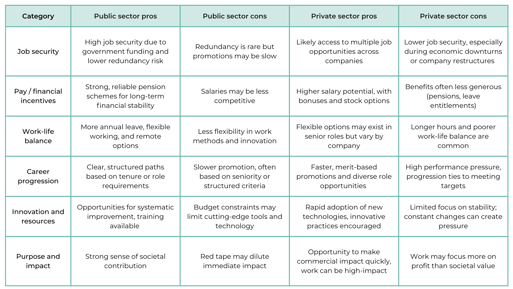
When choosing between the public and private sectors, its important to weigh-up the pros and cons. Here's four pros of working in the public sector that appeal the most to the students I support:
- Job security: Public sector roles often come with a higher degree of job security than their private sector counterparts, thanks to government funding and lower redundancy rates during economic change.
- Pension schemes: Pension schemes are typically more robust in the public sector, offering a stable income after retirement, which can be an essential consideration for long-term financial planning.
- Work-life balance: The public sector often promotes a healthier work-life balance, with more annual leave, flexible working options, and remote work potential. According to the 2025 CIPD Good Work Index, 70% of staff feel able to take time away from work to deal with personal matters.
- Making a difference: Public sector work often involves contributing directly to society. Whether it’s healthcare, education, or community safety, many find satisfaction in knowing they’re making a real impact.
Did you know? The government just launched its first-ever Cyber Profession
Demand for certified cybersecurity professionals in the public sector, particularly within the Civil Service, is growing. With the UK government introducing a new specialist monitoring service, and launching it's first-ever Cyber Profession, now is a great time to switch careers to cyber.

Cons of Working in the Public Sector
Here are, in my experience, the main challenges you can face while working in the public sector:
- Bureaucracy: Government roles can be highly bureaucratic, with rigid internal processes that sometimes slow down decision-making and can lead to administrative delays. The CIPD's 2025 Good Work Index found that only 30% of public sector staff have access to all-department or all-organisation meetings, and only 20% have an employer-provided online forum or chat room for employees.
- Limited flexibility: While work-life balance is generally better, some public sector positions may lack flexibility in innovation and creative approaches due to strict guidelines and regulations.
- Career progression: Promotions in the public sector can sometimes be slower, as advancement is often based on seniority or structured criteria rather than individual performance alone.
- Resource constraints: Budget limitations in the public sector may affect access to cutting-edge tools, technologies, or other resources that could enhance job efficiency and satisfaction.
If you're a tech professional that is primarily motivated by work that has a real-world impact, climbing to the top of your field is less important to you, and you appreciate security and stability, working in the public sector could be right for you.
Did you know? Hybrid working is standard practice in the public sector
According to JobsGoPublic's latest review of their 3000+ live listings, 39% of public sector jobs are hybrid roles, making it the sector's most common workplace arrangement. 76.2% mention some form of flexible working, and one in ten roles listed mention job sharing.
This shows how flexible a career in tech or project management in the public sector can be.
What are Private Sector Jobs? Overview and Roles Examples
Jobs in the private sector are positions within businesses, corporations, or organisations owned by individuals or shareholders rather than the government. Rather than service delivery or societal impact, private sector roles primarily focus on generating profit.
The diverse nature of the private sector - from small independent businesses to huge multinational corporations - means that there is a vast array of tech and project management jobs available. According to the latest data Office of National Statistics (ONS), there are currently 5.7 million private sector businesses in the UK, who employ a total of 28.1 million people.
Some examples of tech private sector jobs include:
- Penetration Tester
- Business Analyst
- IT Services Technician
- Network Engineer
- Cyber Security Analyst
- Project Manager
Pros of Working in the Private Sector
- Salary potential: Private sector roles may offer higher salaries, with opportunities for bonuses and stock-sharing plans, which can add to the overall compensation package.
- Career advancement: Private companies often reward high performance with faster, merit-based promotions, providing employees with chances to take on diverse projects or roles across different departments.
- Innovation and skills development: Private companies tend to adopt the latest technologies and innovative practices more rapidly, giving employees opportunities to build valuable, marketable skills. According to the latest data from CIPD, around half (48%) of managers in the private sector feel that they receive the training, information and time they need to manage their staff well; in the public sector, this figure is nearly 10% lower (39%).
- Fast-paced environment: The private sector is typically faster-paced, with fewer bureaucratic constraints, creating an exciting workplace for those who thrive under pressure.
Cons of Working in the Private Sector
- Lack of job security: Private sector roles may come with less job security, especially during economic downturns or company restructures.
- Work-life balance: Many private sector roles demand longer hours, which can lead to a poorer work-life balance compared to public sector positions. For example, those working in the private sector get on average 25.9 days of annual leave, while those in the public sector get 27.7 days.
- Benefit disparities: Benefits in the private sector, such as pensions and leave entitlements, are often less generous than in the public sector as companies aim to reduce costs.
- Performance pressure: Private sector employees often experience higher performance expectations, with job stability closely linked to meeting targets and producing consistent results.
Fact: Regular earnings in the UK private sector have grown by 3.9%
The latest employment and labour market data by the UK Government revealed that between August to October 2025, employees' annual average regular earnings grew by 3.9% in the private sector.
This illustrates the high earning potential available when working in tech or project management in the private sector.
How to Secure a Tech Job in the Public Sector
If you've decided that the public sector best fits with your career goals and priorities, here are a few actions you can take to prepare for a successful public sector job search:
- Search for and connect with people on LinkedIn who currently work in a tech or project management role in the public sector. Experienced public sector workers tend to share lots of useful news and resources, which can help build your sector knowledge. You could even reach out with a genuine message and ask for a quick chat.
- Attend free or low-cost local networking events, webinars, or industry meetups. Some examples include Civil Service Live, DigiGov Expo and The Emergency Services Show. Just one conversation could lead to a new opportunity.
- Browse public sector specific job boards, like JobsGoPublic, Gov.uk and the Civil Service website. Reading job descriptions will help you tailor your job applications to the public sector. FYI - we have guides and examples to help you when writing your CV and cover letter after switching career to tech or project management.
How to Secure a Tech Job in the Private Sector
As the private sector employees significantly more people in the UK than the public sector, it's likely that you're more familiar with this job-hunting process. However, as someone changing career into tech or project management, you'll still need to take several important steps to help you secure employment in the private sector:
- Build a relevant support network to help create new opportunities. You can do this by joining online communities, forums, or Discord groups, connecting with people on LinkedIn, and by attending local networking events. Interacting with existing tech professionals working in the private sector can open doors, leading to new job opportunities.
- Browse job listings on job search engines like Adzuna or Indeed, or platforms like LinkedIn. Reading an array of job descriptions will help you identify what type of business you'd like to work for. Perhaps you'd prefer the autonomy of working for a SME, or the progression opportunities within a global corporation.
- Plan for future training upskilling. Keeping up-to-date in the fast-moving private sector, particularly when working in tech or project management, is incredibly important for career stability and progression.
Final Thoughts on Choosing Between the Private and Public Sectors
Choosing between a public and private sector role can be difficult - but we're here to help. Once you're certified, the sector you enter ultimately depends on how well each aligns with your personal circumstances and long-term career goals. Assess your priorities, consider the type of work environment where you’ll thrive, and think about factors like salary potential, job security, and work-life balance.
It's important to remember that you can absolutely switch between the public and private sectors! As your career progresses, your priorities will likely shift and so potentially effect which sector is right for you. As a Learning People student or alumni, you can get in touch with our Career Services team for advice and guidance, no matter how far you're into your career in tech or project management. Get in touch to day to kick-start your new career.
Related Articles
 Career Advice
5 Entry-Level Project Management Roles to Kickstart Your Career with No Experience
Are you looking to kick-start your career in project management but have no prior work experience? I’ve collated five entry-level project management roles, alongside the qualifications that’ll help you get them, their typical salaries, and their key responsibilities, to help you secure that all-important first sector role.
Read More Career Advice
A Degree Might Not Be Enough as Employers Look for Skills Training, According to Human Resource Experts
New HR insights show employers increasingly prioritise demonstrable skills over degrees alone. Here’s what that means for professionals building careers in tech and project management.
Read More Business News
This International Women’s Day 2026: Exciting Work Placement Opportunities for Women in Construction
We're excited to announce that we're once again partnering with Women into Home Building to offer our female students a path into construction management.
Read More Career Advice
New Year, New Career – How to Best Prepare Yourself for 2026
This is your go-to guide for preparing for a fresh start, understanding your options, and seeing how Learning People can support you every step of the way.
Read More