

37% of UK STEM Workers Say AI Is Arriving Too Fast: AI impact on white-collar jobs
AI is changing UK tech jobs faster than it's cutting them. See how PM, cyber, data, coding and IT roles are shifting, and the AI skills to learn

AI is changing what UK tech professionals do each day much faster than it is cutting jobs.
Code, alerts, reports and tickets now get a first pass from AI, while employers pay a premium for people who can direct and check that output. Upskilling in AI for your own specialism is the most reliable way to stay relevant.
If you work in tech, AI has probably changed parts of your job before anyone asked how you felt about it. That is why AI upskilling for your specialism now matters as much as your core certifications. Last week, a SThree survey of 885 UK STEM employees found that 37% think their organisation is bringing in AI too quickly to consider the impact on people's roles.
I'm a Tech, IT and Cyber Career Consultant at Learning People, and every week I speak to people already working in IT, cybersecurity, data and software. The question I hear most is how to stay valuable, and keep progressing, as AI takes on more of the routine work.
In this blog, I'll explain what the latest research says about AI and "white-collar" or tech jobs, how the work is shifting in five fields, and the steps you can take to stay ahead. If you'd like advice on the AI skills that fit your role, you can book a free career consultation with one of our Career Consultants.
Written by
With four years at Learning People and a solid foundation in IT and Cybersecurity, Chris guides people through the fast-evolving tech landscape and into their dream jobs. He combines hands-on technical expertise with insider industry insights to help learners make informed career decisions.

How Is AI Affecting White-Collar Tech Jobs in the UK?
So far, AI is changing the tasks inside tech jobs faster than it is changing the number of tech jobs. The clearest evidence comes from a Stanford Institute for Economic Policy Research (SIEPR) policy brief published in July 2026.
Using US data, it found that unemployment among workers in the most AI-exposed occupations has risen by 0.77 percentage points since 2022, slightly less than the 0.85-point rise among the least exposed. The authors read this as a generally softer jobs market rather than an AI-driven collapse.
The UK picture looks similar. The latest KPMG and REC Report on Jobs found that permanent placements fell in October at the second-fastest pace this year, with recruiters pointing to borrowing and energy costs. Even so, they reported growing demand for IT and computing workers.
Where AI is already being felt in white-collar and tech jobs
The pressure shows up in how teams are built. HR leaders quoted in the SIEPR brief say AI's impact is most visible in role consolidation and in roles employers choose not to backfill. Research cited in the same brief also points to weaker hiring of young workers in AI-exposed jobs in both the US and UK since 2022. Interest rates and post-pandemic over-hiring make AI's share hard to isolate.
For people already in post, that changes the shape of progression. In the SThree survey, 29% of UK STEM workers said senior colleagues are now doing work juniors used to handle, and 14% had seen colleagues leave because AI reduced their chances of progression.
Forecasts go further. In a Forbes opinion piece, contributor Amir Husain argues that increasingly capable AI could displace a substantial share of white-collar work within five to ten years. That is one view of the future, so I'd treat it as a reason to prepare rather than a description of today's market.
Does AI Make Tech Professionals More Productive?
AI usually makes tech tasks faster, but the biggest measured speed gains have gone to less experienced workers.
The SIEPR brief cites an experiment in which developers using GitHub Copilot completed a coding task 56% faster, with gains concentrated among less experienced programmers. A separate field study of three companies found more modest gains of 10% to 30%, depending on the firm.
That 56% figure travels a long way on social media, so it helps to know what it measured: one task, in a controlled setting, in 2023. It doesn't mean a team needs 56% fewer people, and it says little about senior work such as architecture, incident response or stakeholder management.
The same research explains where experienced people fit. AI's ability is uneven: strong on some tasks and confidently wrong on others. Deciding whether its output is good enough takes skilled judgement, and that judgement is exactly what someone with a few years in the job has.
As we covered in our blog on how vibe coding has grown up, code that looks finished can still hide security flaws that only a trained eye will catch.
Did You Know? UK Jobs Needing AI Skills Pay a 34% Premium
PwC's 2026 UK AI Jobs Barometer found that the average wage premium for UK jobs requiring AI skills rose to 34.2% in 2025, up from 11% in 2024. Only 2.2% of UK job adverts asked for AI skills, which suggests employers are still competing for a small pool of people who can show them. Read more in our blog on why 70% of UK jobs face AI exposure.

How Is AI Changing Project Management, Cybersecurity, Data, Coding and IT Jobs?
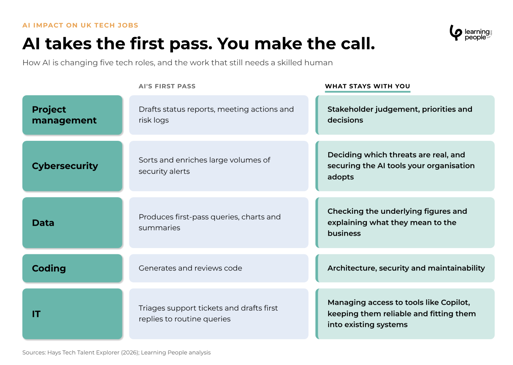
Across all five fields, AI is taking the first pass at routine work while decisions, checks and conversations stay with people. Recruiter Hays' Tech Talent Explorer scores most UK tech roles at around 50 out of 100 for AI impact, meaning some tasks are automated and some upskilling is needed.
- Project management: AI drafts status reports, meeting actions and risk logs, yet Hays gives Project Managers one of the lowest UK AI impact scores (22/100) because the role rests on judgement with stakeholders.
- Cybersecurity: AI sorts and enriches large volumes of alerts, so analysts spend more of their time deciding which threats are real and securing the AI tools their organisation adopts.
- Data: AI produces first-pass queries, charts and summaries, which puts more weight on checking the underlying figures and explaining what they mean to the business.
- Coding: Hays scores UK Java Developers at 57/100, with AI generating and reviewing code while architecture, security and maintainability stay human-led.
- IT: As organisations roll out tools such as Microsoft Copilot, IT teams are the people who manage access, keep them reliable and make them fit existing systems.
Generic AI training won’t future-proof your career.
We think AI training should be vocational. Most AI courses teach you how a tool works. Ours teach you how to use it in the job you actually do. That’s why we’ve built sector-specific AI training into our key pathways, from cybersecurity and data to project management and more. A cyber analyst learns to use AI to triage alerts and secure the tools their organisation adopts. A data analyst learns to check AI-generated queries before the numbers reach the board. A project manager lets AI draft the status report but keeps the judgement calls.
Employers aren’t looking for people who’ve dabbled with a chatbot. They want people who can direct AI in their own specialism and spot when it’s wrong. That only comes from learning AI in context, alongside the certifications and skills your role depends on. That’s what future-proofs a career.
How Can You AI-Proof Your Tech Career?
You can't make a tech career fully AI-proof, so the realistic goal is to become the person who directs and checks AI in your specialism. That is the skill PwC's wage premium rewards, and it builds on the experience you already have. Here's how I'd suggest approaching it:
- List the tasks AI already touches. For one week, note which parts of your job a tool drafts, sorts or summarises. Those tasks are likely to shrink, and everything else on your list is where your value sits.
- Get properly good at one tool in your workflow. Start with whatever your organisation already licenses, and learn it within your company's AI policy. One tool you know well is worth more than ten you've tried once.
- Build the checking skills. Testing, validation, threat modelling and data quality checks are what make AI output safe to use. They're also the skills a hiring manager can't get from the tool itself.
- Get it recognised. A sector-specific AI credential next to your core certification, such as CompTIA Security+, PMP or Microsoft PL-300, gives employers evidence. Add a measurable result to your CV too, such as hours saved on weekly reporting.
- Look one level up. Save 10 job adverts for the role above yours and highlight the AI skills that appear again and again. That's your training list.
Our guide on how to learn AI to future-proof your career goes deeper on choosing your first AI course.
How Learning People Can Help You Build AI Skills for Your Next Tech Role
The most useful AI training for someone already in tech is the AI that belongs to their own field. That's why every Learning People pathway combines recognised technical certifications with sector-specific AI training and coaching in human skills, built around the role you want next. You'll also have a StudentCare™ consultant checking in, and our Career Services team helps with your CV, LinkedIn and interviews when you're ready to apply. 97% of students who complete our three-phase Career Services program land a job.
Student story: moving up within Sky
Edward Caesar-Parker was working as a Broadband Technical Expert at Sky when he enrolled on our Certified Ethical Hacker pathway. He has since earned CompTIA A+, Network+ and Security+, and moved within Sky into a new role as an Insider Risk Analyst.
Your next step
If AI is already changing your role, the best time to plan your next move is while you still have the experience employers value.
Book a free career consultation to talk through your current role with one of our Career Consultants. They'll cover the AI skills that matter for the job you want and a pathway that fits around full-time work. It takes about a minute to request, and a consultant will typically be in touch within one working day.
Latest Sector Guides and Insights
 AI
37% of UK STEM Workers Say AI Is Arriving Too Fast: AI impact on white-collar jobs
AI is changing UK tech jobs faster than it's cutting them. See how PM, cyber, data, coding and IT roles are shifting, and the AI skills to learn
Read More Data
The Uses and Impact of AI in Data Analytics
Discover how artificial intelligence is driving and transforming data analytics, from uncovering deeper insights to driving smarter business decisions. Learn about the key uses, benefits, and real-world impact of AI in analytics, and explore how these innovations are shaping the future of data-driven industries.
Read More Code
Vibe Coding Has Grown Up: What Career Changers Need to Know
AI can now turn plain-language ideas into working apps, but speed without scrutiny creates risk. Here’s how vibe coding has matured, what “doomcoding” warns us about, and why coding fundamentals give career changers the edge.
Read More Getting a Job With No Experience
How to Get a Coding or Software Development Role With No Experience: Expert Guidance
Breaking into coding or software development without experience is possible if you focus on the right skills, build proof through projects, and apply for suitable entry-level roles. In this guide, I walk through the practical steps that can help you get started with more clarity and confidence.
Read More