

Agile vs PRINCE2 vs APM PMQ: Which Should You Choose?
Agile, PRINCE2® and APM PMQ meet different needs. Which certification you should take depends on many factors, including the type of project work you'll be doing, the roles you want, and the industry you'll be working in. Here's how to choose which is best for you.

If you're weighing up agile vs PRINCE2, or wondering where APM PMQ fits, you're facing one of the most common decisions in project management. With 2026 drawing to a close, many people are planning a qualification to start in the new year, and they want to be sure it's one employers ask for.
In my role as Enrolments Director at Learning People, I manage a team of career consultants; they're helping everyone from complete career changers to experienced Project Managers choose between these qualifications.
In this guide, I'll explain what each option is and how they compare on entry requirements, exams and renewal. I'll also cover where PRINCE2 falls short and which certifications to start with for your situation. If you'd rather talk it through in person, you can book a free career consultation with one of our specialist project management Career Consultants.
Written by
With over a decade of experience in project management education and industry, Matt has become our in-house expert. Matt is the Director of Enrolments at Learning People, consistently helping students to advance their careers through learning and certification.

What Is the Difference Between Agile, PRINCE2 and APM PMQ?
The main difference is what each one is: Agile is a way of working, PRINCE2 is a specific project management method, and APM PMQ is a broad knowledge qualification. So you're choosing between three different kinds of credentials.
- Agile: an iterative approach where teams deliver work in short cycles, gather feedback and adjust. You qualify in a specific agile framework, such as AgilePM® from APMG International or Scrum (for example, ABC Scrum Master).
- PRINCE2® (Projects IN Controlled Environments): a process-based method built around defined roles, stages, controls and documents. It's owned by PeopleCert, and the current edition is PRINCE2 7, released in 2023.
- APM PMQ: the Project Management Qualification from the Association for Project Management (APM), the chartered body for the project profession in the UK. It tests knowledge across the whole project lifecycle instead of one method.
In practice, many UK organisations mix them. A Ministry of Defence service assessment, for example, praised a digital team for using agile ways of working inside a traditional PRINCE2 and MSP organisation. A Project Manager with APM PMQ could lead in either kind of setup.
Did you know? UK business leaders now rank adaptability above risk management
APM's Business Leader Index Survey 2025/26 tracked 500 UK CEOs and Managing Directors over a year. It found that adaptability and flexibility overtook risk management as the second most valued skill in project professionals, behind time management. If you're choosing a first qualification, it's worth asking how well it prepares you to adapt when plans change.
Agile vs PRINCE2 vs APM PMQ: Side-by-Side Comparison
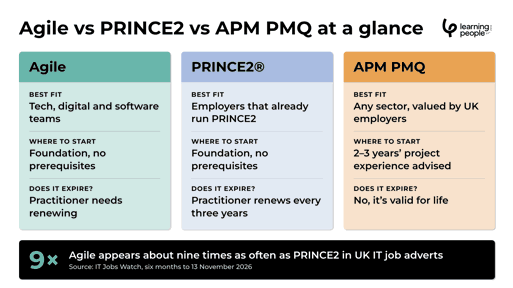
The quickest way to compare them is on who each is for, how it's assessed and whether it expires.
| Agile (AgilePM®) | PRINCE2® | APM PMQ | |
|---|---|---|---|
| What it is | A qualification in an agile project framework | A qualification in one process-based method | A broad project management knowledge qualification |
| Awarding body | APMG International | PeopleCert | Association for Project Management (APM) |
| Starting level | Foundation, no prerequisites | Foundation, no prerequisites | APM recommends 2–3 years' project experience |
| Next level | AgilePM Practitioner (needs Foundation) | PRINCE2 Practitioner (needs Foundation or an accepted equivalent, such as PMQ) | Chartered Project Professional (ChPP), with experience and validation |
| Exam style | Foundation: 50 multiple-choice questions in 40 minutes. Practitioner: scenario-based and open book | Foundation: 60 multiple-choice questions in 60 minutes, closed book. Practitioner: 150 minutes, open book | 2.5-hour online exam, 40 questions worth 90 marks, including short and long written answers |
| Does it expire | Practitioner needs re-registration to stay registered | Practitioner must be renewed every three years | No |
| Best fit | Tech, digital, software, product and change teams | Organisations that already run PRINCE2, often public sector, defence and infrastructure | Any sector, especially UK employers who value APM membership and chartership |
| Typical roles | Agile Project Manager, Delivery Manager, Scrum Master | Project Support Officer, PMO Analyst, Project Manager in PRINCE2 settings | Project Manager, Project Officer, Project Coordinator |
Agile vs PRINCE2: Which Is Better for Your Career?
Agile is the better choice for most people working in, or moving into, fast-moving sectors such as tech, digital and product development. PRINCE2 is the better choice when you're targeting an organisation that already uses it, because your knowledge then maps straight onto how the team works.
Agile ways of working now reach well beyond software teams. GOV.UK's Service Standard, which central government digital services are assessed against, tells teams to use agile ways of working as point 7 of 14. The NHS service standard includes the same point.
PRINCE2 holds its ground in large, governance-heavy projects where sponsors want defined stages, formal sign-offs and an audit trail. That includes parts of central and local government, defence, utilities, construction and infrastructure.
Did You Know? In tech roles, the job market leans heavily towards agile.
According to IT Jobs Watch, 8,515 permanent UK IT job adverts cited Agile in the six months to 13 November 2026, and 1,580 cited Scrum. Only 927 cited PRINCE2, which is roughly one for every nine Agile adverts. PRINCE2's share of permanent IT adverts has also fallen two years running, from 1.17% in 2024 to 0.75% now. Agile's share has dropped over the same period too (from 16.07% to 6.90%), but it's still cited about nine times as often.

According to IT Jobs Watch, 8,515 permanent UK IT job adverts cited Agile in the six months to 13 November 2026, and 1,580 cited Scrum. Only 927 cited PRINCE2, which is roughly one for every nine Agile adverts. PRINCE2's share of permanent IT adverts has also fallen two years running, from 1.17% in 2024 to 0.75% now. Agile's share has dropped over the same period too (from 16.07% to 6.90%), but it's still cited about nine times as often.
If you're unsure, let the job market decide. I'd suggest saving 10 adverts for roles you'd apply for today and counting which qualifications appear.
What happens when you check real job adverts?
When I ask career changers to save 10 job adverts and tally the qualifications, the picture is usually clearer than they expect. Adverts for tech and digital teams tend to ask for Agile or Scrum, while PRINCE2 appears more in public sector and infrastructure roles. The exercise also shows the skills that keep repeating, such as planning, stakeholder management and reporting, which many people have been doing for years under a different job title. That's when the decision gets easier. You're picking the qualification that matches the jobs you want, and you can see exactly which gaps to close.
What about PRINCE2 Agile?
PRINCE2 Agile combines PRINCE2's governance with agile delivery methods such as Scrum and Kanban. It suits Project Managers in PRINCE2 organisations whose teams work in sprints. For most career changers it's a later step, as it assumes you already understand both approaches.
Is PRINCE2 Still Relevant? The Drawbacks You Should Know
Yes, PRINCE2 is still relevant in the UK, mainly in organisations that already use it. It also has real drawbacks if you're aiming for a modern, fast-moving workplace, and you should know them before you pay for it.
PRINCE2 is well known, and its Foundation exam is one of the more accessible first steps into project management. These are the limitations I'd want anyone to weigh up first:
- It teaches one method: PRINCE2 shows you how to structure and control a project the PRINCE2 way. It goes into less depth on the day-to-day craft of scheduling, budgeting, stakeholder engagement and leading a team, which a broad qualification like APM PMQ covers.
- It can feel heavy in fast-moving teams: the method is built around stages, management products and sign-offs. PRINCE2 says it should be tailored to each project, but applied rigidly it becomes paperwork-led, which sits awkwardly with teams releasing work every two weeks.
- Tech and start-up employers rarely prioritise it: these teams tend to ask for Scrum, AgilePM or hands-on agile delivery experience, so PRINCE2 on its own carries less weight there.
- Practitioner certification expires: PeopleCert requires PRINCE2 Practitioner to be renewed after three years, by resitting, passing another PRINCE2 exam or logging CPD points through a paid membership. APM PMQ doesn't expire.
- Foundation alone is a light signal: it shows you know PRINCE2's terms and structure. Employers hiring a Project Manager usually want Practitioner level or real project experience alongside it.
Where PRINCE2 is the right choice
- A job advert you want lists PRINCE2 as essential or desirable.
- Your current or target employer runs projects on PRINCE2, as many UK public sector bodies, defence organisations and infrastructure projects do.
- You're moving into a project support or PMO role in a PRINCE2 organisation, where knowing the stages and documents helps from day one.
- You already hold APM PMQ and want to add the method an employer uses. PeopleCert accepts PMQ as a prerequisite for PRINCE2 Practitioner. [VERIFY: PMQ accepted as Practitioner prerequisite]
Where PRINCE2 is usually the wrong first choice
- You're aiming for tech, digital, software, product or start-up roles.
- You want one qualification that shows broad project management knowledge and won't need renewing.
- You're changing career with no project experience and need to show you understand how projects work across organisations.
- You want to work towards chartered status with APM.
APM PMQ vs PRINCE2: Which Should You Do?
Choose APM PMQ if you want a broad, lifelong qualification that shows you understand project management as a whole. Choose PRINCE2 if an employer specifically asks for it or you'll work inside a PRINCE2 organisation.
APM is the chartered body for the project profession in the UK. PMQ covers areas including life cycles, stakeholder engagement, quality, and risk and issue management. According to APM, the PMQ exam lasts 2.5 hours, with 40 questions worth 90 marks that mix multiple-response questions with short and long written answers.
There are two honest caveats. PMQ is a harder exam than PRINCE2 Foundation, because you have to explain answers in your own words. And APM recommends two to three years of project experience before you take it.
If you're new to projects, the APM Project Fundamentals Qualification (PFQ) is APM's entry point. Many people take PFQ first, then move on to the APM PMQ once they're working on projects. PMQ is also a recognised step towards becoming a Chartered Project Professional, although chartership needs experience and APM's own validation too.
Which Project Management Qualification Should You Start With?
The right starting point depends on your experience and the sector you're aiming for. This is how I'd usually match them:
| Your situation | Start with | Then consider |
|---|---|---|
| New to project management, any sector | APM PFQ or AgilePM® Foundation | APM PMQ once you're working on projects |
| Aiming for tech, digital or software teams | AgilePM® Foundation or ABC Scrum Master | AgilePM® Practitioner |
| Two or more years running projects, with or without the title | APM PMQ | PMP, if you want stronger international recognition |
| Targeting a PRINCE2 employer, or an advert asks for it | PRINCE2 Foundation | PRINCE2 Practitioner, or PRINCE2 Agile if the team works in sprints |
What I recommend for career changers and starters?
For most career changers new to project management, I recommend pairing APM PFQ with AgilePM® Foundation. Neither needs prior experience, and they cover two sides employers look for. PFQ gives you the language and structure of project management that UK employers in any sector recognise. AgilePM Foundation shows you can work in the iterative way many teams now run projects. Together, they're a strong base for a first Project Coordinator or Project Support role. If you're set on tech, digital or software teams, start with AgilePM® Foundation or ABC Scrum Master instead.
If you're comparing PRINCE2 with the PMP instead, our guide to PRINCE2 vs PMP covers that choice in detail.
A qualification gets you considered, but it rarely gets you hired on its own. Most career changers start in a bridging role such as Project Coordinator, Project Support Officer or PMO Analyst, then move up. Our guide to entry-level project management roles explains what each involves.
The pay can make the effort worthwhile. The mean salary for UK project management roles was £63,154 between January and April 2026, according to our project management job market insights.Want a route that pairs the right qualifications with career support?
Our project management training program is designed to take you from no experience to applying for your first project role.
- Key qualifications: industry-recognised APM Project Fundamentals, AgilePM® Foundation V3, AI+ Project Manager Fundamentals, Change Management Foundation, BCS Foundation Certificate in Business Analysis, and AI for Project Management
- Career support: our Career Services team helps with your CV, LinkedIn and interview preparation, and 97% of students who complete our three-phase Career Services program land a job.
- Employer connections: introductions to hiring companies through our employer network.
Hear From Students Who Chose the Agile and APM Route
These Learning People students built their project management careers on agile and APM qualifications, with support from our Career Services and StudentCare™ teams.
Final Thoughts: Agile vs PRINCE2 vs APM PMQ and Your Next Step
If you work, or want to work, where plans change every few weeks, start with an agile qualification. If you want a broad credential that lasts your whole career, APM PMQ is the stronger long-term investment. Choose PRINCE2 when a specific employer or job advert asks for it.
This week, save 10 job adverts for roles you'd apply for and note which of these qualifications they mention. Then book a free career consultation and bring them with you. One of our Career Consultants will help you match a route to those roles. Booking takes about a minute, and a consultant will usually be in touch within one working day.
Agile vs PRINCE2 vs APM PMQ FAQs
Latest Sector Guides and Insights
 AI
PHP Flaw & National AI Warnings: The Critical Importance of the UK Cyber Skills Gap
Critical PHP flaws took 32 UK government services offline in October 2026, and the NCSC now says AI-powered ransomware attacks on critical infrastructure are highly likely by 2028. Both alerts show that the UK needs more people who can find weaknesses, apply fixes safely and keep essential services running.
Read More AI
37% of UK STEM Workers Say AI Is Arriving Too Fast: AI impact on white-collar jobs
AI is changing UK tech jobs faster than it's cutting them. See how PM, cyber, data, coding and IT roles are shifting, and the AI skills to learn
Read More Data
The Uses and Impact of AI in Data Analytics
Discover how artificial intelligence is driving and transforming data analytics, from uncovering deeper insights to driving smarter business decisions. Learn about the key uses, benefits, and real-world impact of AI in analytics, and explore how these innovations are shaping the future of data-driven industries.
Read More Code
Vibe Coding Has Grown Up: What Career Changers Need to Know
AI can now turn plain-language ideas into working apps, but speed without scrutiny creates risk. Here’s how vibe coding has matured, what “doomcoding” warns us about, and why coding fundamentals give career changers the edge.
Read More