

The Microsoft Outage Cause: Why Was Outlook Down Across 74 Countries?
What caused the Microsoft outage across 74 countries? Microsoft points to a months-old software bug, an overloaded networking gateway, and reduced server capacity, rather than a cyberattack. We explain how the failure unfolded, why recovery took so long, and the IT and coding skills that keep systems like this running.

The BBC reported Microsoft 365 connectivity problems in at least 74 countries, and one question followed the disruption: was it a cyberattack?
With cyberattacks so often in the news, that’s an understandable first thought, but not every outage is an attack or a data breach. Microsoft’s explanation of the outage cause points instead to a technical failure involving old code, an overloaded network connection, and reduced server capacity, and the full number of people affected remains unconfirmed.
Below, we explain what caused the outage, why recovery took so long, and how the IT professionals behind the scenes keep systems like this running.
Written by
With four years at Learning People and a solid foundation in IT and Cybersecurity, Chris guides people through the fast-evolving tech landscape and into their dream jobs. He combines hands-on technical expertise with insider industry insights to help learners make informed career decisions.

How Far Did the Microsoft Outage Reach?
The Guardian reported that the disruption hit Outlook, Exchange, and other office software for roughly 24 hours. Microsoft said it had restored service by Saturday, but by then the outage had already interrupted work across schools, healthcare services, courts, businesses, and governments. The company didn’t attribute it to a cybersecurity breach.
The scale matters, but the numbers need care. Microsoft says more than 430 million people use its apps; that isn’t a count of people affected by this outage. Reports from 74 countries show how widely the problem was detected, while the total number of disrupted users is still unknown.
The Microsoft Outage Cause: Three Problems at Once
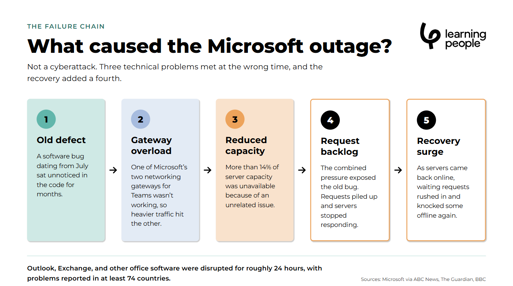
Microsoft executive Charles Lamanna described three interacting causes: a software defect dating from July, heavier traffic on a networking gateway, and reduced server capacity. A gateway directs traffic between systems, and one of Microsoft’s two gateways wasn’t working for Teams. More than 14% of server capacity was also unavailable, and that was down to an unrelated issue.
Lamanna said the capacity reduction caused no impact on its own, but the combined pressure exposed the old defect. Requests piled up, and servers stopped responding. The order of events is what’s worth understanding here, because a bug can sit unnoticed for months while a separate fault changes the conditions around it. Neither problem has to look catastrophic alone for the result to be serious.
When something like this outage hits the headlines, many career changers come to us asking about cyber security first, because that’s the part of tech they hear about most. Once we talk through what they enjoy, some realise that troubleshooting, supporting users, or keeping networks running suits them better, and that’s often where incidents like this one are actually resolved. Both are valuable routes, and the right one depends on how you like to work
Why Microsoft’s Recovery Took So Long
Restoring service proved difficult, because waiting requests surged towards servers as they came back online. Some became unresponsive again, and Microsoft warned that email delivery could remain delayed during recovery. The defect was months old, so it also ruled out the straightforward option of simply reversing a recent code change.
The incident puts a wider kind of resilience in focus. Cybersecurity teams investigate malicious activity and protect systems from attack, but organisations also need working software, spare capacity, and recovery plans that hold up under pressure.
This outage doesn’t measure a tech skills gap or prove hiring demand, but it does show why testing, network monitoring, troubleshooting, and service recovery deserve attention alongside cyber threats.
If you’d like to see what the research does say about demand, our blogs on the size of the UK tech workforce and the cyber security skills gap in UK businesses are a good place to start.
You can also read our Cyber and IT Job Market Insights report, based on exclusive first-party data, recently updated for November 2026.
UK Businesses Need You! How to Start Working in Tech or IT?
If you’re considering a move into tech, you don’t need to understand every part of Microsoft 365 to learn from this failure.
Start with the chain: code handles requests, gateways route them, servers need capacity, and recovery needs planning. If debugging appeals to you, explore coding and software development, and our guide to becoming a Full Stack Developer shows where that route can lead.
If tracing traffic and restoring services sounds more interesting, look at IT, and our guide on how to become an IT Specialist walks you through the role. Your experience solving problems under pressure is useful, but technical skills still take practice, and a foundation course such as IT Foundations gives you somewhere sensible to begin.
A lot of the people I speak to who end up in IT support or service desk roles are career changers who didn’t start in tech. They’ve often come from customer-facing or admin jobs where they were already the person who stayed calm and worked through the problem when something broke. That’s the same habit an outage like this calls for. The technical knowledge can be learned, and a foundation course gives you the language and tools to build on the problem-solving you already do.
Hear From Students Who Chose the Agile and APM Route
Zac Elisara felt stuck in a retail job with no future when he got in touch with Learning People to explore a career in IT. He completed a series of CompTIA qualifications and, with help from our Career Services team, moved into a role as a Junior Systems Administrator.
Explore the Skills Behind Reliable Systems
Learning People’s IT and coding courses can help you build a foundation in how systems work and how to troubleshoot them.
If the first question you asked was “was it an attack?”, cybersecurity is another route to explore, alongside the skills that keep services running, and our guide on how to become a Cyber Security Specialist explains what that path involves. If you’re not sure which route suits you, one of our Career Consultants can talk it through with you in a free career consultation.
Latest Sector Guides and Insights
 AI
AI Strategy Should Be About People First, According to New Reports from Deloitte & Harvard
Only 6% of organisations are making progress on how people and AI work together. See why AI strategy should put people first, and which skills matter.
Read More AI
PHP Flaw & National AI Warnings: The Critical Importance of the UK Cyber Skills Gap
Critical PHP flaws took 32 UK government services offline in October 2026, and the NCSC now says AI-powered ransomware attacks on critical infrastructure are highly likely by 2028. Both alerts show that the UK needs more people who can find weaknesses, apply fixes safely and keep essential services running.
Read More AI
37% of UK STEM Workers Say AI Is Arriving Too Fast: AI impact on white-collar jobs
AI is changing UK tech jobs faster than it's cutting them. See how PM, cyber, data, coding and IT roles are shifting, and the AI skills to learn
Read More Data
The Uses and Impact of AI in Data Analytics
Discover how artificial intelligence is driving and transforming data analytics, from uncovering deeper insights to driving smarter business decisions. Learn about the key uses, benefits, and real-world impact of AI in analytics, and explore how these innovations are shaping the future of data-driven industries.
Read More