

What Are Soft Skills and Why Are They So Important for Tech Professionals?
As AI transforms tech roles, employers increasingly value soft skills like communication, adaptability and emotional intelligence alongside technical expertise. This guide lists the key soft skills, explains why they matter in tech and project management, and offers practical steps to develop them.

The tail-end of summer often causes us to reflect on where we're headed - particularly in our careers. For those of us working in the ever-evolving tech and IT sectors, regular upskilling is essential, and developing soft skills is a crucial part of this.
With AI transforming the way we work, the demand for tech professionals who are equipped with more than just certifications and "hard skills" is growing. Increasingly, employers are seeking well-rounded individuals who demonstrate strong interpersonal and cognitive capabilities among other soft skills.
These human-centric strengths are essential in areas across tech and IT, such as: cybersecurity, software development, data analysis, cloud computing and project management.
This guide explores the role of soft skills in tech and IT career paths, why they’re essential in a digital-first workplace, and how you can develop them to enhance your employability and long-term career growth.
Written by
Chelsey Murray is a dedicated Careers Services Consultant at Learning People, bringing a wealth of recruitment experience and deep expertise in the tech and project management job markets.

What are Soft Skills?
Soft skills refer to the interpersonal, emotional and cognitive abilities that allow you to communicate, collaborate and adapt effectively. Soft skills are sometimes also called transferable skills or employability skills by employers.
Soft skills are becoming increasingly important in today's job market, particularly with the rise of AI. They tend to be developed through life experiences and are therefore not limited to the workplace. Strong soft skills can help you build meaningful relationships, better manage conflict, and effectively navigate social situations. In fact, The OECD (Organisation for Economic Co-operation and Development) recently reported that individuals who receive soft and technical skills training earn 20‑27% higher incomes.
Unlike hard skills, which are job-specific and teachable (like Python programming or understanding network security protocols), soft skills are human capabilities that are valuable and transferable across many industries and roles. They are intangible and subjective and so can't be measured in the same way as hard skills - but this doesn't make them any less important.
Fact: Soft Skills are Crucial for AI Roles
Cornerstone's 2026 Skills Economy Report revealed that 95%+ of AI Engineer roles require emotional intelligence. Additionally, demand for 'resilience and flexibility' has grown by 42%, 'leadership and social influence' by 28%, and 'creative thinking' by 18%.
Having a mix of soft skills and hard skills is key in the tech sector.

Soft Skills List - 15 Examples and Meanings
Some of the most common and in-demand soft skills examples include:
- Communication: Expressing ideas clearly, listening actively, adapting your message for different audiences.
- Problem-solving: Approaching challenges with creativity, logic and resilience.
- Adaptability: Thriving in changing environments and embracing new tools and processes.
- Emotional intelligence: Recognising and managing your own emotions while responding empathetically to others.
- Teamwork and collaboration: Working harmoniously with colleagues to achieve shared goals.
- Leadership: Inspiring and guiding teams, regardless of job title.
- Time management: Organising and prioritising tasks effectively to make the best use of available time.
- Creativity: Generating unique ideas and innovative solutions by approaching problems from different angles.
- Empathy: Recognising, understanding, and responding to your own and others' emotions in a considerate and supportive way.
- Active listening: Focusing on and understanding another individual's message fully. This includes picking up on non-verbal cues, asking follow-up questions and providing constructive feedback.
- Conflict management and resolution: Identifying the underlying cause of conflict, and then diplomatically coming to a solution that is the best for all parties.
- Critical thinking: Analysing information objectively to make reasonable and fully-informed decisions.
- Stress management and emotional resilience: Staying calm under pressure and quickly adapting to overcome challenges.
- Attention to detail: Approaching work with care and accuracy to ensure that nothing gets overlooked, no matter how small.
- Initiative: Taking action and solving problems without being prompted.
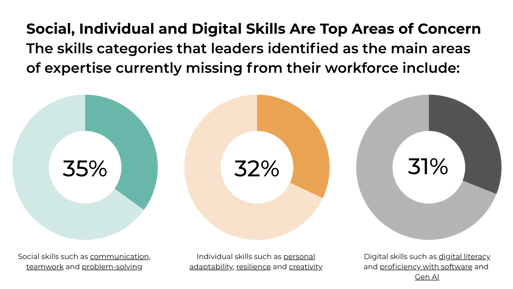
These are the skills that help you navigate real-world workplace scenarios, especially in fast-paced, innovation-driven industries like tech and IT. In fact, the number of people looking to proactively improve their soft skills is on the rise in the UK and around the world.
Reasons Why Soft Skills are Important in Tech
From cloud computing to the rapid developments in AI, new tools and methodologies are constantly emerging - but, no matter which technical skills are most in demand, soft skills like communication and collaboration will always be critical skills in the tech sector.
AI is transforming every aspect of our lives, from education to the workplace, and businesses clearly recognise this shift...
"For graduates, this creates a huge opportunity to build the skills that are needed in the current and future workforce. This is especially true considering the gap between organisational appetite for AI and their existing capabilities for successful AI integration...
...The future of AI success lies in human oversight. AI doesn’t replace people, it amplifies those who are equipped to use it wisely."
Here’s how soft skills elevate your value as a tech professional:
- Strong communication and collaboration fuel success: Whether you’re explaining a technical issue to a non-technical stakeholder or working in an Agile development team, being able to communicate with clarity and empathy keeps projects on track and teams aligned, especially in hybrid and remote work environments.
- Problem-solving and critical thinking drive innovation: Modern tech roles often require creative, proactive solutions. Critical thinking enables professionals to interpret data, anticipate problems and implement effective fixes; skills that are crucial in areas like cybersecurity or data analysis.
- Adaptability keeps you ahead of the curve: The tech landscape is constantly evolving. Professionals who embrace continuous learning and adapt quickly to new systems or frameworks are far more likely to succeed in the long term.
- Emotional intelligence fosters better workplace relationships: Whether it's managing client expectations or resolving internal team conflicts, high emotional intelligence helps build trust, improve collaboration and maintain a healthy work culture.
- Leadership and teamwork build resilient teams: In tech, leadership isn’t just for managers. It’s about taking initiative, guiding peers and contributing to a positive team dynamic, qualities that are just as critical as your ability to code or manage a Gantt chart.
Fact: Soft Skills Are Crucial for Project Managers
According to the World Economic Forum, over a third (39%) of today's core workplace skills will change by 2030, largely due to AI. Having a combination of technical, human and AI skills is vital - and this includes project management and delivery professionals.
Although it's no secret that hard AI skills are in-demand in the project management sector, "humanness" is still at the heart of project management.

Four Tech Roles where Soft Skills are Vital
While soft skills are universally beneficial regardless of sector, cyber, software, project and data roles tend to require these specific skills more:
- Cybersecurity Professionals must combine attention to detail and analytical thinking, with the ability to communicate complex threats clearly.
- Software Developers rely on patience, creativity and team collaboration to write, test, and optimise code.
- Project Managers need strong leadership, organisation and negotiation abilities to balance timelines, resources and stakeholder needs.
- Data Analysts thrive when equipped with critical thinking, curiosity and the communication skills to present insights to decision-makers.
By aligning your soft skills development with your chosen tech pathway, you’ll not only improve your performance but also increase your potential for progression.
Ask a career advisor...
"I think a lot of people I advise don't think they have soft skills when, in reality, they are just overlooking them. It's become second nature and therefore, people don't register it as a "skill".
In reality, you are practising and honing those skills every day in life and in work, it's about knowing how to display them and provide appropriate evidence and context on your CV and in interviews to demonstrate how they benefit your potential employer."
Fact: Demand for People Skills is on the Rise in 2026
According to LinkedIn's 2026 Skills on the Rise report, people skills such as leadership, people management and stakeholder communication are some of the fastest-growing and most in-demand for 2026.
How to Develop Your Soft Skills Inside and Outside of the Workplace
Soft skills can be cultivated through conscious effort, practice and learning, like any valuable skill set. There are certainly soft skills courses you can do to improve your aptitude in this area - but there are also less formal things you can start doing immediately.
Here are seven practical ways you can develop soft skills:
- Seek feedback regularly: Ask colleagues, mentors, or managers how you can improve your communication, teamwork, or leadership abilities.
- Invest in learning: Enrol in soft skill development courses that focus on public speaking, conflict resolution, emotional intelligence, and other core areas.
- Adopt active listening: When engaging with others, give them your full attention. Validating your colleagues with active listening will result in stronger professional relationships.
- Take on diverse projects: Working across departments or disciplines introduces new perspectives and challenges, helping you become more adaptable.
- Practice self-awareness and empathy: Reflect on your responses during stressful situations and actively listen to others’ viewpoints to build emotional intelligence.
- Engage in group work: Get involved in team projects to build stronger collaboration and interpersonal skills. You'll learn how to thrive alongside people with a range of working styles.
- Explore role-play simulations: Platforms like Udemy offer AI-powered tools to help practise interpersonal scenarios in a realistic, interactive way.
How our Soft Skills Course Helped Jose Land a Job in Web Development
Jose got in contact with us as he was looking to upskill to progress his career in Web Development. After completing our Soft Skills training course, he was able to land an exciting new role.
Ready to Future-Proof Your Career with Soft Skills? We Can Help!
At Learning People, we understand that success in the digital age requires soft skills as well as technical credentials. That’s why our career-ready courses in cybersecurity, data, software development, cloud computing, and project management are designed to integrate technical learning with essential soft skill development.
Now is a great time to upskill. Autumn brings increased recruitment drives, opening more doors for those wanting to change careers. Our Learning Pathways are curated to equip you with both the hard and soft skills needed to succeed in modern workplaces.
Soft skills are no longer optional, they’re essential. By developing these human-centric abilities alongside your technical expertise, you’re not just increasing your employability, you’re unlocking your full potential. That's why we've recently improved our AI training offering - all of our pathways ensure that our students have a balance of industry-specific technical, human and AI skills.
Request a call-back to speak to one of our expert Career Consultants today to find out how we can support your journey to becoming a more confident, capable, and in-demand tech professional.
Soft Skills FAQs
Related Articles
 Getting a Job With No Experience
How to Write a CV for a Job With No Experience
Learn how to write a CV that shows skills, training and projects when you have no work history and read example 'no experience' CVs
Read More Changing Career
How to Write a Career Change Cover Letter, with Examples
When changing careers, the way you apply for jobs will be different from usual, and this includes how you write your cover letter. As a career advisor, I share some of the advice, tips, and tricks for writing a career change cover letter, as well as an adaptable cover letter template and examples.
Read More Changing Career
How to Change Career at 50: The Steps and Advantages of a Later-in-Life Career Change
Changing careers at 50 isn't just possible: it can be the start of your most rewarding work yet. Experience, resilience, and transferable skills give older career changers a real advantage, opening doors into high-paying, flexible fields like project management, cybersecurity, and data analysis.
Read More Getting a Job With No Experience
How to Write a Cover Letter for a Job With No Experience
Learn how to write a confident cover letter for a job with no experience. Use our clear framework to highlight skills, motivation and potential.
Read More