

Data Analyst Careers: How to Become a Data Analyst
Starting salaries from £35K-£50K | Earn above the national average
Learn the skills, certifications and practical steps needed to become a job-ready Data Analyst in 2026, even if you’re starting from entry level or changing careers.

Data analysts collect, clean, and interpret data to help organisations make smarter decisions. To become one, learn technical skills like Excel, SQL, and Tableau, build a portfolio of projects, and apply for entry-level roles.
Businesses in 2026 rely on data to make better decisions, reduce costs, understand customers, improve operations and track performance. That is why Data Analysts are becoming so valuable. They sit at the centre of this shift, turning raw numbers into useful insight.
For career changers and starters, this can be a practical route into tech and digital careers because you do not need to become an advanced programmer on day one. Recent industry data lists Big Data Specialists among the fastest-growing roles to 2030.
In this guide, I’ll walk you through exactly what a Data Analyst does, what the role involves day to day, which qualifications can help get you hired, and the practical steps to work towards your first Data Analyst role.
Written by
With 11 years under his belt at Learning People, Stuart has helped over 100 people find the course programs they need to land their dream roles in tech, cyber, data, coding, and IT.

Want the most cost-effective way to launch your data analytics career?
Our complete data training program is one of the fastest, most cost-efficient ways to go from "no experience" to "job market ready" in just a matter of months. We deliver everything you need to break into the industry and get hired:
-
Key Qualifications: Earn the exact credentials employers demand.
-
Bespoke Coaching: Get personalised guidance to ace your interviews.
-
Exclusive Network: Gain direct introductions to hiring companies.
Visit our page below to learn more about our career-launching program and its pricing.
1. What Is a Data Analyst?
A Data Analyst collects, cleans, organises and interprets data to help a business make better decisions. They turn numbers, spreadsheets, dashboards and reports into clear answers to real business questions.
They bring real value to a business by replacing guesswork with evidence. A good Data Analyst helps teams understand what is happening, why it matters, and what action to take next.
This is a role that spans multiple seniority levels. While Data Analyst can be a realistic entry-level target, many professionals work towards it after starting in reporting, operations, marketing, finance, admin or Excel-heavy roles where they already use data to support decisions.
Can Data Analyst be an entry-level role?
Yes, there are certainly entry-level Data Analyst roles out there, and demand for people to fill them. In fact, this role can be a good entry route into tech and digital careers, even if you do not have formal data experience yet.
You do not need to become a data scientist or advanced coder to get started. The key is to build the right foundations, starting with Excel, dashboards, basic statistics and data cleaning.
Recognised training and certifications can help you show employers that you understand the tools and methods used in the role. A small portfolio of documented projects, such as cleaned datasets, can also help prove what you can do before you land your first data job.
What does a Data Analyst do? Core responsibilities
A Data Analyst gathers, cleans and studies data to answer business questions. They create reports, dashboards and recommendations that help business and teams make better decisions.
Core responsibilities usually include:
-
Data collection: Gathering data from spreadsheets, databases, surveys, CRM systems, web analytics tools or business platforms.
-
Data preparation: Fixing errors, removing duplicates and making data reliable enough to use.
-
Data analysis: Looking for trends, patterns, gaps and changes in the numbers.
-
Dashboard and report building: Turning analysis into clear visuals, charts, tables and summaries.
-
Insight communication: Explaining what the data means in plain English and recommending next steps.
Day in the life of a Data Analyst
Daily life for a Data Analyst is a mix of problem-solving, technical work and communication. A typical day might include:
-
Checking data requests: Reviewing what a manager, team or client needs to understand from the data.
-
Cleaning data: Preparing spreadsheets or database exports so they are accurate and usable.
-
Digging into the data: Using Excel, SQL, Power BI, Tableau or Python to find patterns.
-
Shaping the story: Presenting findings visually in a way teams understand and can actually use.
-
Explaining insights: Sharing what the data shows, why it matters and what should happen next.
What is a Data Analyst’s salary?
Data Analyst salaries in the UK commonly range from around £25,000 to £55,000+, depending on location, sector, tools and seniority.
Junior roles usually sit at the lower end, while experienced analysts with strong practical skills and recognised certifications, such as CompTIA Data+, Microsoft Certified: Azure Data Fundamentals DP-900 or Microsoft Power BI Data Analyst Associate PL-300, can move into higher-paying roles faster.
2. Certifications You Need to Become a Data Analyst
Recruiters in 2026 use certifications as a benchmark for job-ready data knowledge, especially when someone is changing careers. In a field where many applicants are self-taught, these credentials help prove that you have been trained in the tools, methods and reporting skills employers expect.
|
Level |
Recommended Certification Path |
Professional Value |
|
Foundation |
Builds foundational knowledge of data concepts, databases and Microsoft Azure data services. It can be a great starting point if you are starting from scratch. |
|
|
Entry-Level |
Validates core data analytics skills, including data mining, analysis, visualisation, governance and reporting. A strong option for aspiring Data Analysts. |
|
|
Professional |
Proves you can prepare, model, visualise and analyse data using Power BI, one of the most common tools in analyst roles. |
|
|
Advanced |
Helps you move beyond reporting into more advanced areas such as Python, modelling, machine learning and data science. |
For those serious about becoming a Data Analyst, our data analytics courses can be tailored to your goals, starting point and target roles, so you build the right skills and certifications for the jobs you want to apply for.
3. Key Skills Required for a Data Analyst
To become employable as a Data Analyst, you need technical confidence and the ability to explain findings clearly. The job is not just “being good with numbers”. It is about using data to answer practical business questions.
Technical & hard skills a Data Analyst needs
-
Excel and spreadsheets: Excel is still one of the most common tools for organising, cleaning and analysing business data, especially in entry-level roles.
-
Data visualisation: Tools such as Power BI or Tableau help you turn analysis into dashboards, charts and reports that teams can actually understand.
-
Basic statistics: Understanding averages, percentages, trends, outliers and correlation helps you avoid misreading the data or drawing unsupported conclusions.
-
Data cleaning: Analysts spend a lot of time preparing messy data so it is accurate, consistent and reliable enough to use.
-
Python basics: Python is useful for automation, larger datasets and more advanced analysis, although not every entry-level Data Analyst role requires it.
Core soft skills a Data Analyst needs
-
Curiosity: Good analysts ask why something changed, not just report that it changed.
-
Communication: Effectively explaining findings to people who do not work with data every day.
-
Business understanding: Strong analysis links data back to revenue, customers, operations, risk, marketing or performance.
-
Attention to detail: Small errors can lead to poor decisions, so accuracy matters.
-
Problem-solving: You need to break vague questions into clear, answerable analysis tasks.
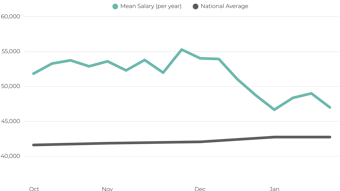
Did You Know? Data professionals earn above the national average salary
The mean salary for data roles October 2025 to January 2026 inclusively is £50,412, representing a 5.8% YoY increase.
Despite an decline at the end of 2025, mean salaries for data roles consistently exceed the national average. Learn more in our data analytics job market mini-report.
4. The Roadmap: How to Become a Data Analyst (Step-by-Step)
Becoming a Data Analyst takes a tactical approach, especially if you are just starting out. You are not just learning tools; you are learning how to answer important business questions using data.
Step 1: Research Data Analyst job descriptions
Start by looking at current job descriptions for Junior Data Analyst roles.
Notice the tools and requirements that keep appearing. You will likely see Excel, Power BI, Tableau, Python, dashboards, reporting, data cleaning and stakeholder communication. This gives you a much clearer picture of what employers actually want.
Step 2: Master the data basics
Before jumping into advanced tools, start with the basics. Build confidence with Excel, data cleaning, formulas, pivot tables, charts and basic statistics.
You also need to understand what clean data looks like. Poor data leads to poor decisions, so learning how to spot missing values, duplicates, errors and odd results is a big part of the job.
Step 3: Earn your professional validation
Once you understand the basics, focus on the tools and certifications that employers recognise. CompTIA Data+ is a strong starting point because it covers the practical data skills used in analyst roles.
From there, Microsoft certifications can help you build more role-specific confidence. These certifications give your CV the professional weight it needs to pass recruiter checks and Applicant Tracking Systems, especially if you do not yet have “Data Analyst” in your job history.
Step 4: Build a portfolio that proves your data skills
Once you have started learning the tools, you need to show employers what you can actually do with them. A small data portfolio can make a big difference, especially if you are applying without formal data analyst experience.
Build two or three simple projects using public datasets or realistic business scenarios. For each one, show the question you were trying to answer, the data you used, how you cleaned it, what you found, and what you would recommend next.
Step 5: Apply for entry-level roles
Your CV, LinkedIn and cover letters should make your new direction obvious. Instead of only listing past duties, translate your experience into data language. For example, “created weekly reports” becomes “prepared performance reports to support business decisions.”
Add your tools and certifications clearly and include a link to your portfolio near the top of your CV or LinkedIn profile so recruiters can see practical evidence quickly.
Then apply for realistic first roles, such as Junior Data Analyst, Reporting Analyst, BI Assistant, Data Technician, Marketing Analyst or Operations Analyst. You can also look for bridge roles where data, reporting or dashboards are part of the job, even if the title is not “Data Analyst” yet.
Conclusion: What’s My Next Move for Becoming a Data Analyst?
Becoming a Data Analyst is a realistic goal for beginners and career changers, as long as you build the right mix of tool skills, business understanding, recognised certifications and practical evidence.
Your next step is to look at current job descriptions for Junior Data Analyst roles. Take note of the tools and certifications employers keep asking for, such as Excel, Power BI, CompTIA Data+, Microsoft Azure Data Fundamentals and Microsoft Power BI Data Analyst Associate. Then plan how you can learn and prove those skills through structured training and portfolio projects.
Our data training program is the fastest, most cost-efficient way to acquire the skills and get hired, thanks to its blend of qualifications, skills training, career coaching, and direct job placement opportunities.
You can talk to a dedicated data career consultant (for free) about your career ambitions and how we can help you by hitting the button below. (One of our team will be in touch very soon, typically within one working day.)
Hear from people who have completed our data career training program
Business update: Our new online store is now open!
Looking for a fast, affordable way to learn data skills and earn digital badges? Our short online data courses on our new online store Learning People Lite start from just £149 and take as little as 8 hours to complete.
